Themes

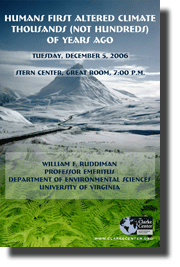
Humans First Altered Climate Thousands (Not Hundreds) of Years Ago

Tuesday, December 5, 2006
Humans First Altered Climate Thousands (Not Hundreds) of Years Ago
Stern Center, Great Room, 7:00 p.m.

Ruddiman

Issue in Context
The earth’s climate naturally goes through periods of warming and cooling. Currently, the average temperature of the planet is increasing at an alarming rate. The most common conjecture of environmental scientists is that human actions are accelerating the natural warming of the planet. The amount of greenhouse gases, like carbon dioxide (CO 2 ) and methane (CH 4 ), present in the atmosphere has increased, due in part to human consumption of fossil fuels such as oil, coal and natural gas. Most scientists attribute this increase to the population growth and the industrialization of the past few hundred years in human history. However, William F. Ruddiman, a professor emeritus from the Department of Environmental Sciences at the University of Virginia suggests that significant human intervention in the natural operation in the climate system actually began 5,000 to 8,000 years ago. Even while the world population was relatively small, heavy deforestation and rice irrigation in Eurasia , compounded by additional emissions from an unusually warm ocean caused a shift in global climate. Ruddiman suggests that by the start Read more

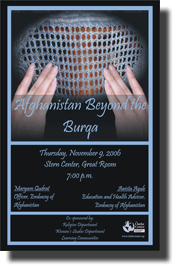
Afghanistan Beyond the Burqa

Thursday, November 9, 2006
Afghanistan Beyond the Burqa
Stern Center, Great Room, 7:00 p.m.

Afghanistan Beyond Burqa
Issue in Context
A free and compulsory education is viewed by many as one of the most fundamental of all human rights. However, at least 125 million worldwide children are denied basic education and one in three adults remain illiterate, according to the Global Campaign for Education.

Under the Taliban, basic education declined between 1996 and 2001, causing an increased percentage of illiteracy and low rate of school attendance. School curriculum was restricted, schools were destroyed and female education was banned. The government closed all of the girls’ schools in the country and prevented female teachers from working. Some girls were secretly educated in their homes by parents and teachers, others attended underground schools. In 2000, UNICEF reported that only 4% to 5% of Afghan children were being educated at the primary school level. Fewer had access to secondary and university education. By 2001, Afghanistan possessed one of the worst educational records in the world.

Since the Taliban fell from power in 2001, international efforts led by numerous countries negotiated an aid package of $4.5 billion to help rebuild Afghanistan. More than a million attend school Read more

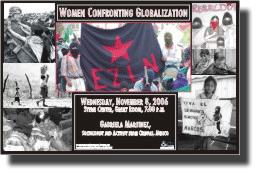
Women Confronting Globalization

Wednesday, November 8, 2006
Women Confronting Globalization
Stern Center, Great Room – 7:00 p.m.

Women Globalization

Issue in Context

Ninety percent of Mexico ‘s potable water comes from Chiapas, but many communities have no access to fresh water. Similarly, Chiapas is Mexico’s top producer of hydroelectric energy and a major producer of natural fuels, and yet most of Chiapas ‘ indigenous people live without electricity. The Zapatistas, a largely non-violent revolutionary group struggling for the autonomy of indigenous people, has spent the last two decades raising awareness of local conditions domestically and internationally. Early in the Zapatista’s history, women joined the ranks and many rose to leadership positions, eventually creating the “Revolutionary Laws of Women,” which explicitly provided for equal rights for women in Zapatista-controlled areas. While the government has made changes in Chiapas, the region still suffers.

About the Speaker
Gabriela Martinez is a sociologist, activist, and researcher who worked with the Center of Political Analysis and Social and Economic Research in Chiapas, Mexico. Martinez has focused her studies and community work on the collective rights of indigenous communities, liberation theology, and fair trade and women’s cooperatives.

Celeste Escobar will translate for Martinez at this event. Escobar, originally from Paraguay , Read more

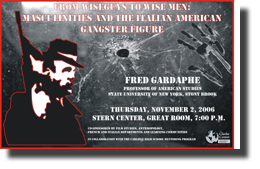
From Wiseguys to Wise Men: Masculinities and the Italian American Gangster Figure

Thursday, November 2, 2006
From Wiseguys to Wise Men: Masculinities and the Italian American Gangster Figure
Stern Center, Great Room, 7:00 p.m.

Wiseguys to Wisemen
Issue in Context
What does one associate with an Italian-American: pasta, large families, nice clothes, masculine men, and the mafia? These are some of the common stereotypes Americans have had about Italians living in the United States since they began arriving in the late 19 th century. Violence, sexism, machismo, overt sexuality and an obsession with abundance have characterized the persona of the Italian-American gangsters of yesterday in films such as The Godfather or Goodfellas. Represented as highly physical, the images of Italian men have helped construct what it meant to be an American man. The “wiseguy” character expresses both the experience of Italian immigrants and native fantasies that reveal the culture of American race, gender, and ethnicity. The wiseguy figure can be interpreted as a “trickster” character long employed as a metaphor in American literature to serve as a model of improper behavior.

About the Speaker
Fred Gardaphe is the director of the American and Italian American Studies Program at the State University of New York at Stony Brook. He teaches courses in Italian American history and Read more

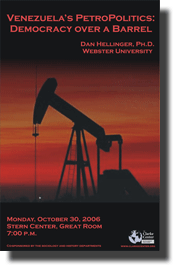
Venezuela’s PetroPolitics: Democracy over a Barrel

Monday, October 30, 2006
Venezuela’s PetroPolitics: Democracy over a Barrel
Stern Center, Great Room, 7:00 P.M.

Venezuela's Petropolitics

Issue in Context
Home of the fifth largest oil industry in the world, Venezuela has gained increasing economic and political clout in the midst of a global scarcity of oil. Venezuela’s oil policy has polarized the country’s domestic politics, culminating in the 2002 coup that nearly removed its populist president, Hugo Chavez, from office. In addition to triggering intense public debate on the home front, Venezuela’s oil politics and its effects on the country’s domestic and foreign relations have alarmed governments around the world. Despite criticism from the U.S. administration and oil CEOs, Chavez has utilized his country’s oil revenues to promote his idea of democratic socialism by creating a vast array of social programs that have boosted his popularity among Venezuelans. Chavez has also allocated oil revenues to fund an aggressive diplomatic agenda. In light of an upsurge in global terrorism, oil policy in Venezuela has dramatically transformed the country’s position in the sphere of global politics, as world leaders have linked Chavez’s actions to broader questions of national security. Pat Robertson’s controversial request that the U.S. administration “take out” Chavez demonstrates the Read more

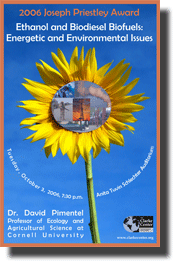
Ethanol and Biodiesel Biofuels: Energetic and Environmental Issues

Tuesday, October 3, 2006
Ethanol and Biodiesel Biofuels: Energetic and Environmental Issues
Anita Tuvin Schlechter Auditorium, 7:30 p.m.

Ethanol and Biodiesel Biofuels
Issue in Context
Though the U.S. has less than 4% of the world’s population, it is responsible for 22% of the carbon dioxide released worldwide from the burning of fossil fuels. The release of carbon dioxide is the greatest contributor to global warming. The high energy usage of the United States makes alternative energy sources essential in reserving the pollution and dependence on fossil fuels. Ethanol, an energy source derived from corn, soybeans, and switch grass, has been touted as a clean alternative to fossil fuel. However, the production of ethanol requires a lot of energy – through farming and harvesting to deriving ethanol. The fuel used to produce it may be more than the energy it provides.

About the Speaker
David Pimentel is a professor of Ecology and Agricultural Science at Cornell University . His research includes population ecology, biological control, biotechnology, sustainable agriculture, land and water conservation, and environmental policy. Pimentel has served on many national and government committees including the National Academy of Sciences, the President’s Science Advisory Council, the U.S. Department of Energy, and the U.S. State Department. Read more

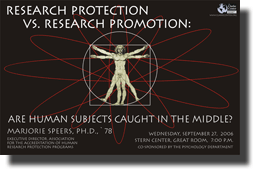
Research Protection vs. Research Promotion

Wednesday, September 27, 2006
Research Protection vs. Research Promotion
Stern Center, Great Room, 7:00 p.m.

Research Protection vs. Research Promotion

Issue in Context
The basis of all science lies in repeatable experiments that yield evidentiary results for or against a hypothesis. The only way to obtain relevant results about human response is to utilize human subjects in the experiment. However, doing experiments with human subjects instigates a deluge of complications. The demand for better regulation of human research experiments began with the Nuremburg Code after the Nazi exploitation of unconsenting prisoners of concentration camps. Now Institutional Review Boards (IRBs) carefully examine every step of the research process, from experiment design to the relevance of the potential findings to selecting human subjects. These boards, established by the US Department Health, Education and Welfare, are responsible for determining and preserving the fine line between sufficiently protecting research subjects and unnecessarily hindering research processes.

About the Speaker
Marjorie A. Speers, Ph.D is the current executive director of the Association for the Accreditation of Human Research Protection Programs (AAHRPP). From 1999 to 2001 she was acting Executive Director of the National Bioethics Advisory Commission. She also managed the development of a report on the research oversight system, “Ethical and Read more

The Making of Memories

Thursday, March 27, 2006
Common Hour
The Making of Memories
Weiss Center, Rubendall Recital Hall, 12:00 p.m.

Issue in Context
Memory is an essential quality of being human. Our individual and collective sense of identity depends on the workings of memory. Until recently, memory was studied largely as an aspect of philosophy. Modern technological advances make it possible for neurologists to examine memory’s biological operations, including long-term potentiation, (LTP). LTP occurs when one nerve cell stimulated by another, remembers the stimulation, and forms a cellular bond. This transformation of the nerve cell is essential to the storage of memory. The brain contains over 100 billion nerve cells, each with thousands of synapses. Whenever a memory is formed, some of these synapses change. As they are continually stimulated their surfaces are permanently altered forming connection points with other nerve cells. These contact points are the foundation for the contact and chemical alterations in the nerve cells that serve as memory units.

Cultural memory is a facet of every society. It is passed down collectively through generations, preserved in forms such as theatre, arts, literature, music and ritual. As an illustration of cultural memory, this event presents music and text from a Read more

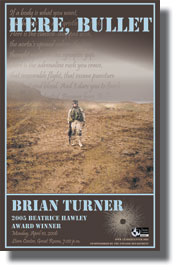
Here, Bullet

Monday, April 10, 2006
Here, Bullet
Stern Center, Great Room, 7:00 p.m.

Here Bullet
Issue in Context
A majority of the poems in Here, Bullet were written during Turner’s one-year tour in Iraq and reflect the struggle to understand his place in the War and the world. This first-hand account of the War in Iraq stands as a powerful witness to the actual events of the War. The poems are neither politically skewed nor do they make moral assumptions. Instead, they leave the reader to draw conclusions and feel the poetry.

The first and only of Brian Turner’s published books to date, Here, Bullet has garnered national acclaim. Both author and poetry have been featured in many publications and radio broadcasts, including Maine Things Considered and NPR. Here, Bullet is the recipient of the 2005 Alice James Books’ Beatrice Hawley Award.

Reviews of Here, Bullet

• “The day of the first moonwalk, my father’s college literature professor told his class, ‘Someday they’ll send a poet, and we’ll find out what it’s really like.’ Turner has sent back a dispatch from a place arguably more incomprehensible than the moon—the war in Iraq —and deserves our thanks…”
– The New York Times Book Review Read more

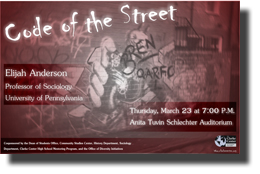
Code of the Street: Violence and the Inner City Poor

Thursday, March 23, 2006
Code of the Street: Violence and the Inner City Poor
Anita Tuvin Schlechter Auditorium, 7:00 p.m.

Code of the Street
Issue in Context
In an attempt to explain why many urban youths are prone to commit acts of violence and aggression, Dr. Anderson has identified a common set of street mores, termed the “code of the street.” Often termed “street justice,” the code allows individuals to command respect in society and alleviates the problems of inner city violence by relying on a strategy of deterrence. Often, the threat of implied violence is used to avoid the use of actual violence

The code reaches beyond the limits of the law, and helps residents gain a sense of security and belonging. The concept of “street justice” provides an alternative method for afflicted inner-city areas to manage their own problems in the face of an increasingly ineffectual police force.

About the Speaker
Elijah Anderson is the Charles and William L. Day Distinguished Professor of the Social Sciences and a professor of sociology at the University of Pennsylvania. He is the director for the Philadelphia Ethnography Project, associate editor of Qualitative Sociology, and a member of the board of directors of the American Academy Read more

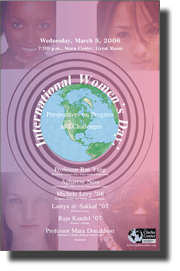
International Women's Day: Perspectives on Progress and Challenges

Wednesday, March 8th, 2006
International Women’s Day: Perspectives on Progress and Challenges
Stern Center, Great Room, 7:00 p.m.Womens Day

Issue in Context
International Women’s Day takes place on March 8th of each year. The celebration was created by German Socialist Klara Zetkin in 1911. On International Women’s Day in 1917, Russian women were inspired to protest the rising costs and shortages of food, the world war, and their increased suffering. After 1917, March 8 became the official date for the celebration. When feminism surged in the 1960’s, interest in the holiday revived, and in 1975 the United Nations begun to sponsor International Women’s Day. In 1981, in Santa Rosa California a National Women’s History Week was spearheaded to bring international women together. In 1987 the week was expanded to an entire month, making March National Women’s History Month. Today, women from all over the world come together annually to celebrate peace, equality, and justice. This evening’s panel will discuss progress on women’s issues as well as persistent challenges regarding women’s rights.

About the Speakers
Rae Yang is a professor of Chinese language and literature in the East Asian Studies Department at Dickinson College. She was born in China and held several Read more

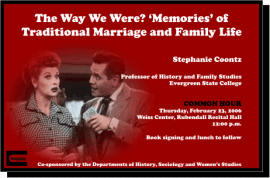
The Way We Were? 'Memories' of Traditional Marriage and Family Life

February 23, 2006
COMMON HOUR
The Way We Were? ‘Memories’ of Traditional Marriage and Family Life
Weiss Center, Rubendall Recital Hall, 12:00 p.m.
The Way We Were

Issue in Context
During the 19th century, the age of sexual consent in some states was as low as nine or ten; alcoholism and drug abuse were more rampant than at present. During the “family-oriented” 1950s, teenage childbearing peaked. These facts belie the popular belief that traditional values of marriage and family thrived before recent times.

Through her research, Stephanie Coontz has revealed that the US is undergoing a “distressful and disorganizing social and economic transformation made all the more difficult by our romanticizing of a past that never existed as we choose to remember it. The so-called traditional family is no longer the norm and should not be made the ideal. Single-parent families cannot be considered abnormal anymore, and divorce is not an excuse for problematic children.”

Coontz believes that the ills of society most often receive the blame for the breakdown of the “traditional” marriage. She argues that the strengths of more diverse forms of family life must be recognized in order to solve these ills.

About the Speaker
Stephanie Coontz is currently a professor Read more

Avian Influenza and the Economics of Bio Security

Thursday, February 16, 2006
Avian Influenza and the Economics of Bio Security
Stern Center, Great Room, 7:00 p.m. Issue in Context
A form of avian influenza, known as “fowl plague,” first appeared in Italy around 1878. It was first recognized in the United States in 1924, and occurred again in 1929. The disease was eradicated both times. In recent months, concern surrounding avian influenza has escalated. The latest cases lie along the migratory routes of birds, as in Turkey , where the H5N1 strain has taken several lives. The greatest fear, however stems from the possibility that H5N1 may evolve into a form of disease that will cause a virulent global human pandemic with a high mortality rate.

The threat posed by avian influenza is causing growing fear and raising many questions: Is fear justified? What are the scenarios for public health, the economy, and society? What are the underlying driving forces of this disease, and what can and should be done in response?

About the Speaker
Stephen Aldrich is the founder and President of Bio Economic Research Associates (bio-era), a leading independent research and advisory firm providing insight into the future of living systems and the global bio economy. Read more

It's a Gas! Petroleum and Energy Transitions in American Life

February 13, 2006
It’s a Gas! Petroleum and Energy Transitions in American Life
Stern Center, Great Room

It's a Gas
Issue in Context
The global petroleum industry was born in the Appalachian Basin in Titusville, Pennsylvania when the first well was drilled in the summer of 1859. At the time, nobody could have predicted that the discovery of this resource would result in an era of unparalleled growth and development. Since then, the use of petroleum as a source of energy has become a defining characteristic of the 20th century.

However, with the dawn of the 21st century some concern has begun to surface about surging oil prices. It is said that inexpensive energy fueled the “American century” of growth and development. With the end of the era of inexpensive energy, we face either a future of high cost energy or transition to more affordable energy sources.

Dr. Black examines where petroleum-based living has carried us during the 20th century and takes a glance towards the future to come to terms with our current petroleum conundrum.

About the Speaker
Brian Black teaches history and environmental studies at Pennsylvania State University, Altoona. His research emphasis is on the landscape and environmental history of North Read more

Women and Politics

Thursday, February 9, 2006
Running as a Woman: How Stereotypes Influence the Conduct and Consequences of Political Campaigns
Weiss Center, Rubendall Recital Hall, 12:00 PM

Women, Media and Politics
Stern Center, Great Room, 7:00 PM

Running as a Woman

Issue in Context
Throughout the course of history, women have been the subject of oppression and countless stereotypes. Over the past few decades, general views of women have begun to change drastically. Women now are able to hold professional positions and command respect in a manner they were not able to in the early part of the century. In regards to electoral politics, however, the success of women tends to be directly correlated to stereotypical images of female candidates and the prominent issues of the day. The manner in which the general public perceives the capabilities and liabilities of today’s female candidate can greatly affect the operation and outcome of a political campaign. Additionally, stereotypes have a tendency to influence such aspects of campaigns as media coverage, the candidates’ behavior, and voters’ opinions. They may also shape the electoral climate, providing women with an advantage in some settings and a disadvantage in others.

The recent elections of female candidates around the globe combined with the Read more

Indigenous Australia: A Contemporary Snapshot

Wednesday, February 8
Indigenous Australia: A Contemporary Snapshot
Stern Center, Great Room, 7:00 p.m.

Australia Poster
Issue in Context
Indigenous Australians, commonly called Aborigines, form one of the oldest surviving cultures in the world. Native art, music, a strong faith, and family systems are key characteristics of the rich aboriginal culture, from the didgeridoo to dreamtime to fire-stick farming. Believed to have arrived in Australia about 40,000 years ago, there were 350-750 distinct groups with different dialects and languages when English colonists arrived in the eighteenth century.

Settlers did not value the native customs and values and gradually forced simulation across the country. Massive dispossession of traditional lands, disease and direct violence caused a 90 percent population decrease of Aborigines between 1788 and 1900. The population plummet eventually leveled as communities developed resistance to diseases and adapted to their circumstances. However, many of the tribal cultures and languages had been lost. Their traditional nomadic lifestyle was no longer viable with the increase of appropriated land, and many Aborigines worked on farms, paid for their labor with food, clothing and other basic necessities. They were not legally Australian citizens, and could not vote. Further family and cultural damage occurred from the Australian government’s Read more

Liberal Arts Education, Leadership and Business Management

Tuesday, November 29, 2005
2005 Rush Award
Liberal Arts Education, Leadership and Business Management
Stern Center, Great Room, 7:00 p.m.

Liberal Arts Education

Issue in Context
Marvin Suomi of the Kajima Corporation once said “Somehow we have failed miserably in communicating to students and parents the importance of a well-rounded education in the business world. Today, perhaps more than ever, we need the depth of perspective that a liberal arts education can bring to decision making, product development, leadership, and other dimensions of business.”

Based on Mr. Suomi’s statement, one can easily begin to understand how much the business world has evolved in just a few decades. In the past, there was a clear bias within firms where specialized education was strongly preferred to liberal arts education in terms of background for employment. However, as the job market has evolved, so have the criteria for employment. Increasingly, firms are looking for individuals who exhibit skills in problem solving, the capacity for cross-cultural understanding, and the ability to place key decisions in broader social and historical contexts.

As more corporations become multi-national, the demand for liberal arts educated analysts in the business world continues to soar. The value of better understanding of human nature Read more

The First September 11: The Tragedy of U.S. Moral Ambivalence Toward Democracy and Torture in the "Condor Years" in Latin America

Wednesday, November 16, 2005
The First September 11: The Tragedy of U.S. Moral Ambivalence Toward Democracy and Torture in the “Condor Years” in Latin America
Stern Center, Great Room, 7:00 p.m.

First September 11
Issue in Context
When Americans hear the term 9/11, few associate it with the September 11, 1973 overthrow of Chile ‘s democratic government that marked the onset of cooperation between the United States and military regimes in Latin America. During the next decade, Washington turned a blind eye to the conduct of military regimes in Chile, Argentina, Uruguay, Bolivia, Paraguay, and Brazil that perpetrated horrific human rights abuses against both violent revolutionaries and defenders of democracy. In the name of combating the spread of communism, the United States backed a secret campaign to liquidate Latin American dissidents who sought asylum in other countries, “Operation Condor.” The Operation’s spies entered neighboring Latin American countries to track, monitor, and kill political adversaries. The most notorious Condor assassination took place in Washington, DC, in September 1976, when agents planted a car bomb that killed Chile’s former foreign minister Orlando Letelier and an American woman.

About the Speakers
John Dinges is a former foreign correspondent to Latin American countries and author of three Read more

The Age of Genocide

Tuesday, November 15, 2005
2005 Morgan Lecture
The Age of Genocide
Anita Tuvin Schlechter Auditorium, 7:00 p.m.

Genocide
Issue in Context
Genocide is defined by the Convention on the Prevention and Punishment of the Crime of Genocide as the deliberate and systematic destruction,“in whole or in part of a national, ethnical, racial or religious group.”

During World War II, Winston Churchill stated that the world was facing “a crime without a name.” In the wake of the Holocaust, Raphael Lemkin, a Polish legal scholar, sought to formulate a term that could encompass the killings, the objectives, and the methods of the Nazis against the Jewish population of Europe. Lemkin coined the word “genocide” from the Greek “genos” (race or tribe) and the Latin suffix “cide” (to kill). Lemkin’s struggle for the universal recognition of international law defining and forbidding genocide brought about the Convention on the Prevention and Punishment of the Crime of Genocide.

Remembering the Holocaust, American leaders such as Jimmy Carter and George Bush, Sr. promised that “never again will the world fail to act in time to prevent this terrible crime,” but the history of the 20th century proved that genocide happened again and again across the globe. Read more

Presidential War Powers: From Lincoln to Bush

Thursday, November 3, 2005
Presidential War Powers: From Lincoln to Bush

Presidential War

Part I: Common Hour DEBATE: Resolved: The War in Iraq is Just
David Perry, professor of ethics at the U.S. Army War College
Russ Bova, professor of political Science at Dickinson College.
Weiss Center, Rubendall Recital Hall, 12:00 p.m.

Part II: Teach-In. When Does a War End?: War Powers and the Lessons of Reconstruction after the American Civil War
Michael Vorenberg, author of Final Freedom and professor of history at Brown University
Stern Center, Great Room, 2:00 p.m.

Part III Roundtable: Presidential War Powers: Historical Perspectives from Lincoln to Bush
John Yoo, former deputy assistant attorney general in the Office of Legal Counsel of the U.S. Department of Justice and professor of law at the University of California at Berkeley
Louis Fisher, Senior Specialist in Separation of Powers for the Congressional Research Service of the Library of Congress; and Michael Vorenberg, author of Final Freedom and professor of history at Brown University
Stern Center, Great Room, 7:00 p.m.

Issue in Context- Debate
There is much political debate in America today over whether the most recent war in Iraq meets the criteria necessary for a war to be considered just. Read more