Themes

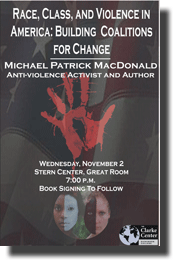
Race, Class, and Violence in America: Building Coalitions for Change

Wednesday, November 2, 2005
Race, Class, and Violence in America: Building Coalitions for Change
Stern Center, Great Room 7:00 P.M.

Race Poster
Issue in Context
Between 1973 and 1994, the poverty rate for children in young families has doubled. Meanwhile, violent crime committed by youths has increased more than 78% in the past six years. According to statistics, shortly after the year 2050, the white majority in America will dissipate. This information is used on hate websites to negatively influence and scare young people into believing America is not the country it once was. It is clear that coalition building is more important than ever if the current younger generation is to have any hope for a successful future.

Thirty years ago, white residents of a Boston neighborhood, known as Southi, pelted school buses carrying black students with rocks and tomatoes. This area of south Boston had the highest concentration of impoverished whites in America in the 1970’s; Southie also represented the face of racism in the northeast. Mob murders, drug abuse, teen pregnancy, and frequent funerals for young people were rampant. Few insiders then or now have spoken out about this aspect of Boston.

Michael Patrick MacDonald grew up in Southie Read more

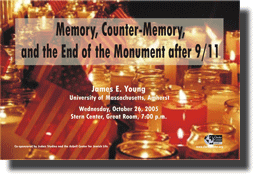
Memory, Counter-Memory, and the End of the Monument after 9/11

Wednesday, October 26, 2005
Memory, Counter-Memory, and the End of the Monument after 9/11
Stern Center, Great Room, 7:00 p.m.

memorial-poster.gif

Issue in Context
Constructing monuments to commemorate tragedies such as the Holocaust and 9/11 can trigger intense debate as designers strive to represent the collective memory of a grieving nation. Much of the controversy stems from the aesthetic and political dilemmas involved in creating national monuments. The United States and Germany recently faced such predicaments while constructing the World Trade Center Site Memorial in New York City and the National Holocaust Memorial in Berlin . The memorials in both countries strive to convey the full spectrum of citizens’ sentiments, but each monument has received criticism for falling short. Since historical events are open to so many interpretations, one wonders if it is possible to construct a monument that captures the full range of emotion and memory.

About the Speaker
James E. Young is a renowned scholar of Holocaust remembrance and an internationally recognized expert on memorial architecture. He was appointed to the selection committees for both the National Holocaust Memorial in Berlin and the World Trade Center Site Memorial in New York City .

Young has written numerous articles concerning Read more

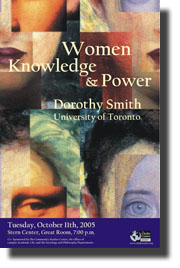
Women, Knowledge & Power

Tuesday, October 11, 2005
Women, Knowledge & Power
Stern Center, Great Room 7:00 P.M.

womenposter.jpg

Issue in Context
In 1833, Oberlin College became the first co-educational college in the United States. The 19th Amendment, giving women the right to vote, was ratified in 1920 and Congress passed the Equal Employment Opportunity Act in 1972. In 1981, Sandra Day O’Connor became the first woman appointed to the U.S. Supreme Court.

The word “feminist” first appeared in the 19th century and the modern feminist movement took off with passion in the 1960s. Yet, though the twentieth century saw a wave of progress in achieving women’s rights, many believe that women still have obstacles to overcome.

Dorothy Smith has argued forcefully that some of those obstacles lie squarely within the academy and in the nature of scholarly work and scientific research. In particular, Smith contends that commonly accepted social science models are problematic for women, and indeed for everyone, because women’s experience did not play a role in their development. Though women have made tremendous strides in the field of sociology over the past century, Smith believes that sociology (and more generally the social sciences) remains dominated by a male perspective and ideology. Thus, Read more

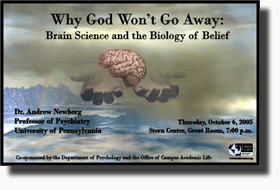
Why God Won’t Go Away: Brain Science and the Biology of Belief

Thursday , October 6, 2005
Why God Won’t Go Away: Brain Science and the Biology of Belief
Stern Center, Great Room 7:00 P.M.

Brain Science

Issue in Context
Many minds of the 19th century viewed religion as mere superstition which an increasingly enlightened society would soon discard. Yet today, in the most technologically and scientifically enlightened age, religious observance remains strong in the United States: church affiliation has never been higher, and more than seventy percent of the American population claims to believe in God.
Dr. Andrew Newberg, professor of psychiatry at the University of Pennsylvania, examines whether or not religion is the product of biology, a kind of neurological illusion. Do our brains function in such a way as to make God seem not only real, but reachable?
Together with the late Dr. Eugene d’Aquili, Dr. Newberg conducted research using advanced imaging techniques to gain a further understanding of what occurs inside the brains of Buddhist and Franciscan nuns at prayer. What they discovered was that intensely focused spiritual contemplation triggers an alteration in the activity of the brain that leads one to perceive transcendent religious experiences as solid, tangible reality. This discovery suggests that God seems to be hard-wired into Read more