All posts by admin

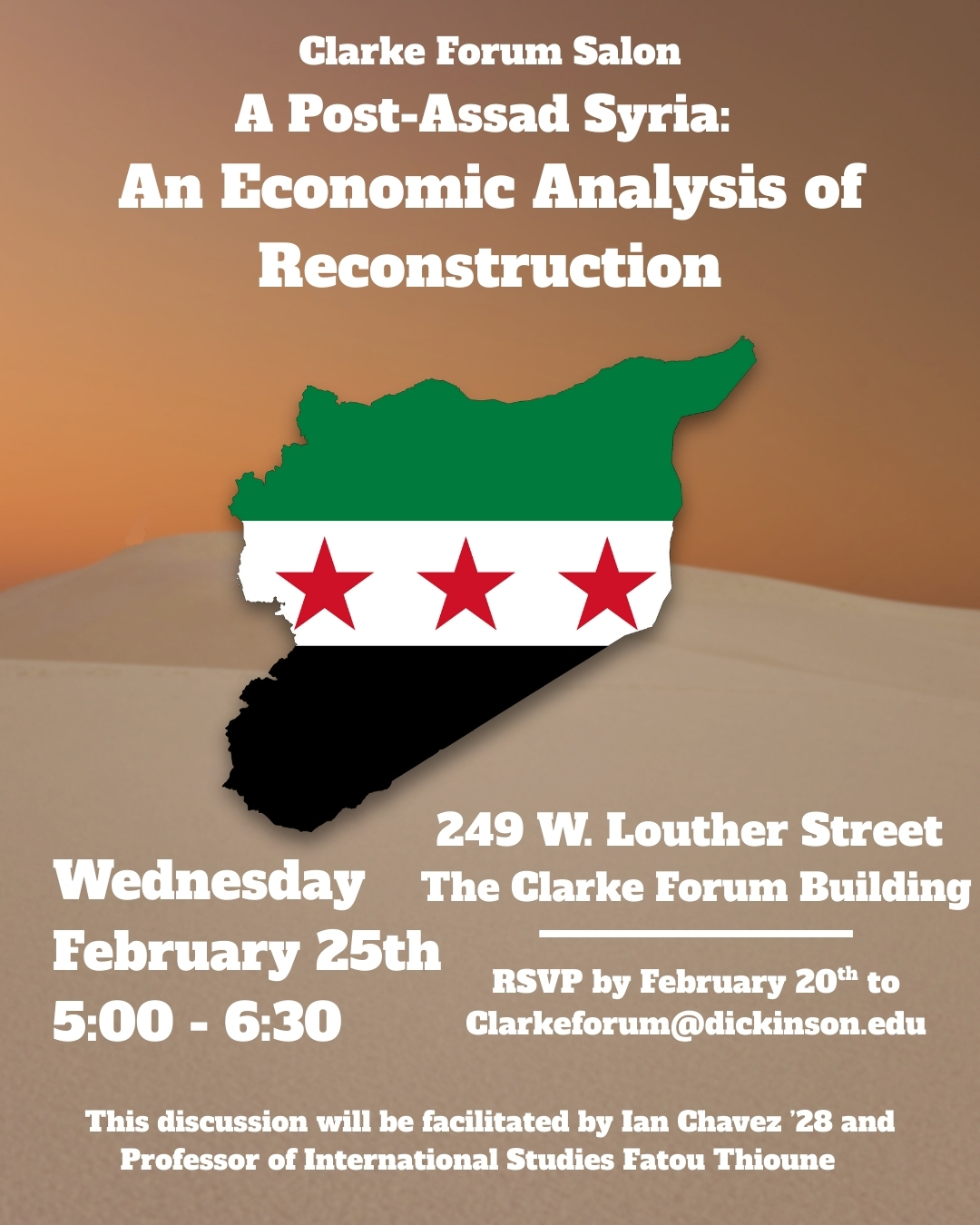
Wednesday, February 25, 2026 – A Post-Assad Syria: An Economic Analysis of Reconstruction

Clarke Forum Salon: A Post-Assad Syria: An Economic Analysis of Reconstruction
Date: Wednesday, February 25, 2026
Time: 5:00 – 6:30 p.m.
RSVP: By Friday, February 20, 2026 to clarkeforum@dickinson.edu. Space is limited.  More information will be sent once we receive your RSVP.

The Syrian Civil War (2011 – 2024) ravaged the once vibrant nation of Syria. The war’s impact is clear in the destruction of major cities like Aleppo, Homs, Raqqa, and parts of Damascus. It created a refugee crisis that challenged the current refugee system and contributed towards the far-right gaining ground in Europe as groups continue pointing to immigration as a cause for alarm.1 An unstable Syria creates a power vacuum that hostile non-state actors could seek to exploit just as ISIS did during the Syrian Civil War. The security of Syria is crucial and has security implications globally, but how can the nation rebuild after such destruction?

The civil war shattered the Syrian economy ,reflected in the freefall of Syria’s GDP after 2011 and its skyrocketing inflation.2 Rebuilding the country is estimated to cost around $216B USD, with nearly one third of the country’s pre-conflict gross capital stock damaged.3 Leading the overthrow of the decades-long Assad Read more

Snapshot of Spring 2026 Programming

Tuesday, February 3, 2026
Black History Month Cornerstone Program
The Psychology of Belonging: Navigating Identity on a College Campus
Beverly Daniel Tatum, President Emerita of Spelman College & Author

Tuesday, February 17, 2026
Democracy and the Arts
Shannon Jackson, UC Berkeley

Thursday, February 26, 2026
Real-World Effects of AI
Panel Discussion

Tuesday, March 17, 2026
Combating Online Harms: The Importance of Rigorous Scientific Testing of Proposed Interventions
Joshua A. Tucker, New York University

Wednesday, March 25, 2026
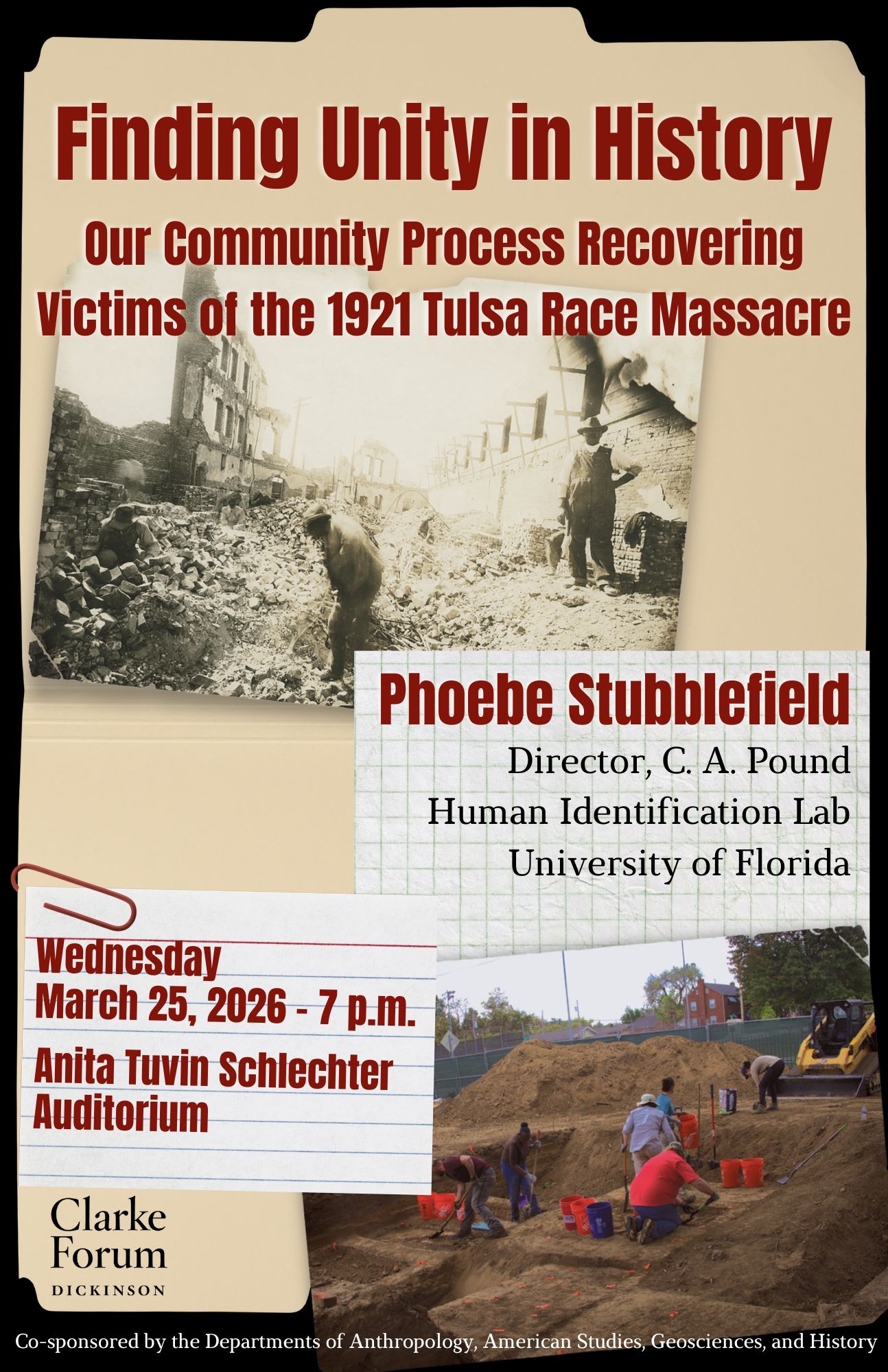
Finding Unity in History: Our Community Process Recovering Victims of the 1921 Tulsa Race Massacre
Phoebe Stubblefield, University of Florida

Tuesday, March 31, 2026
The Archive
Neta Pulvermacher, Jerusalem Academy of Music and Dance (JAMD)

Tuesday, April 7, 2026
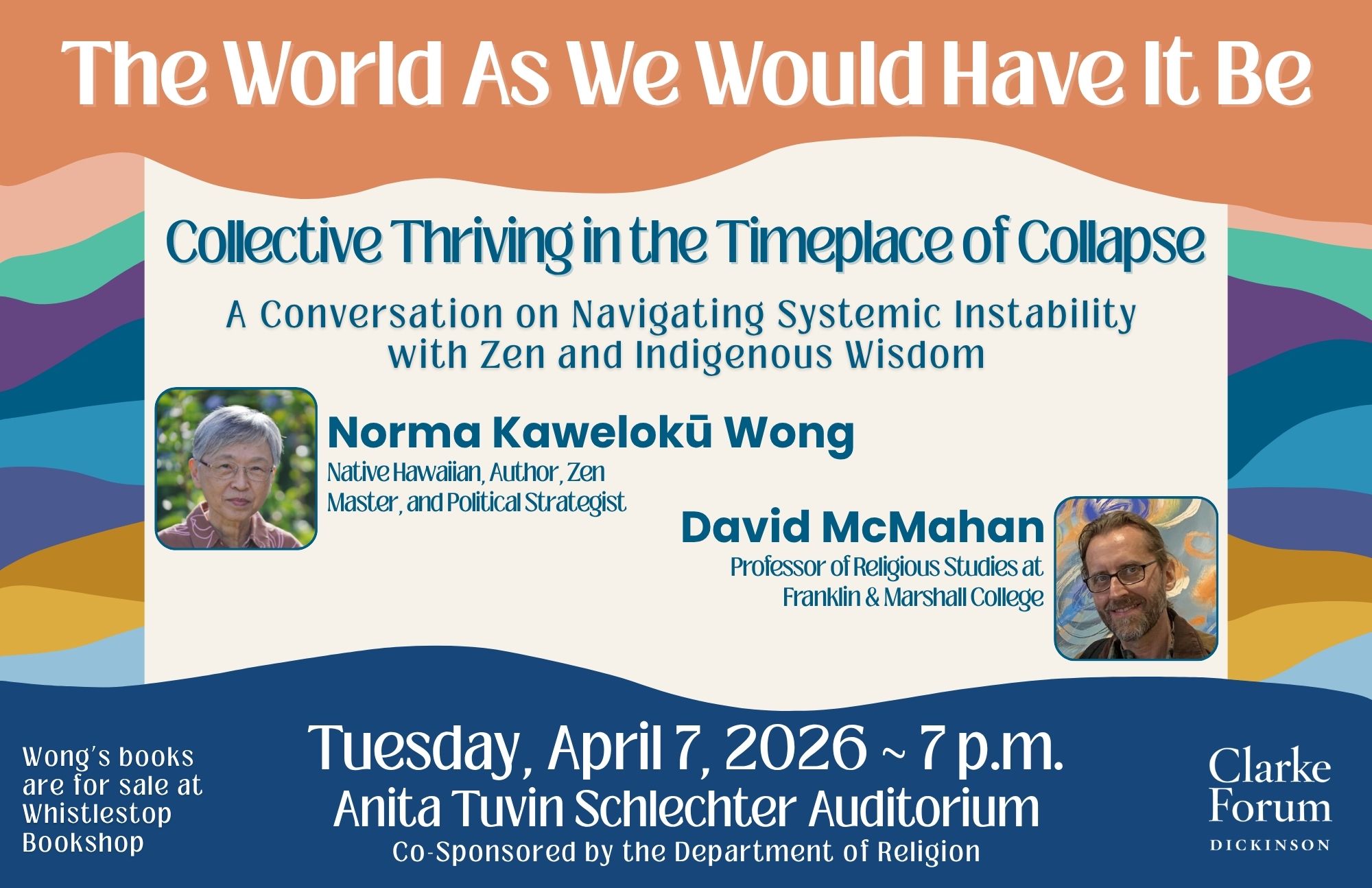
The World As We Would Have It Be: Collective Thriving in the Timeplace of Collapse
Norma Kawelokū Wong, Native Hawaiian and Hakka writer/teacher, 86th generation Zen master, and political strategist

Monday, April 13, 2026
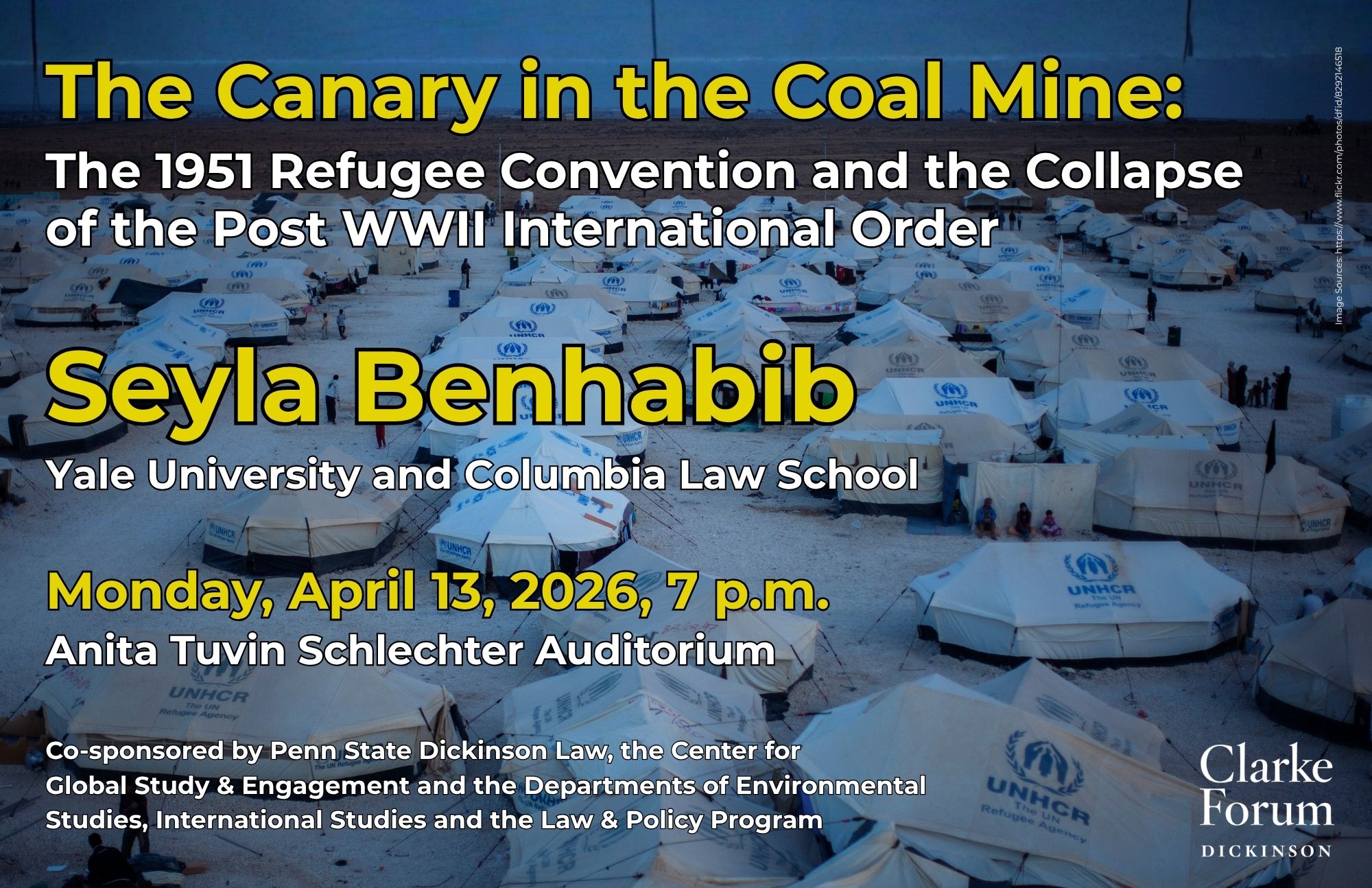
The Canary in the Coal Mine: The 1951 Refugee Convention and the Collapse of the Post WWII International Order
Seyla Benhabib, Yale University

Monday, April 20, 2026
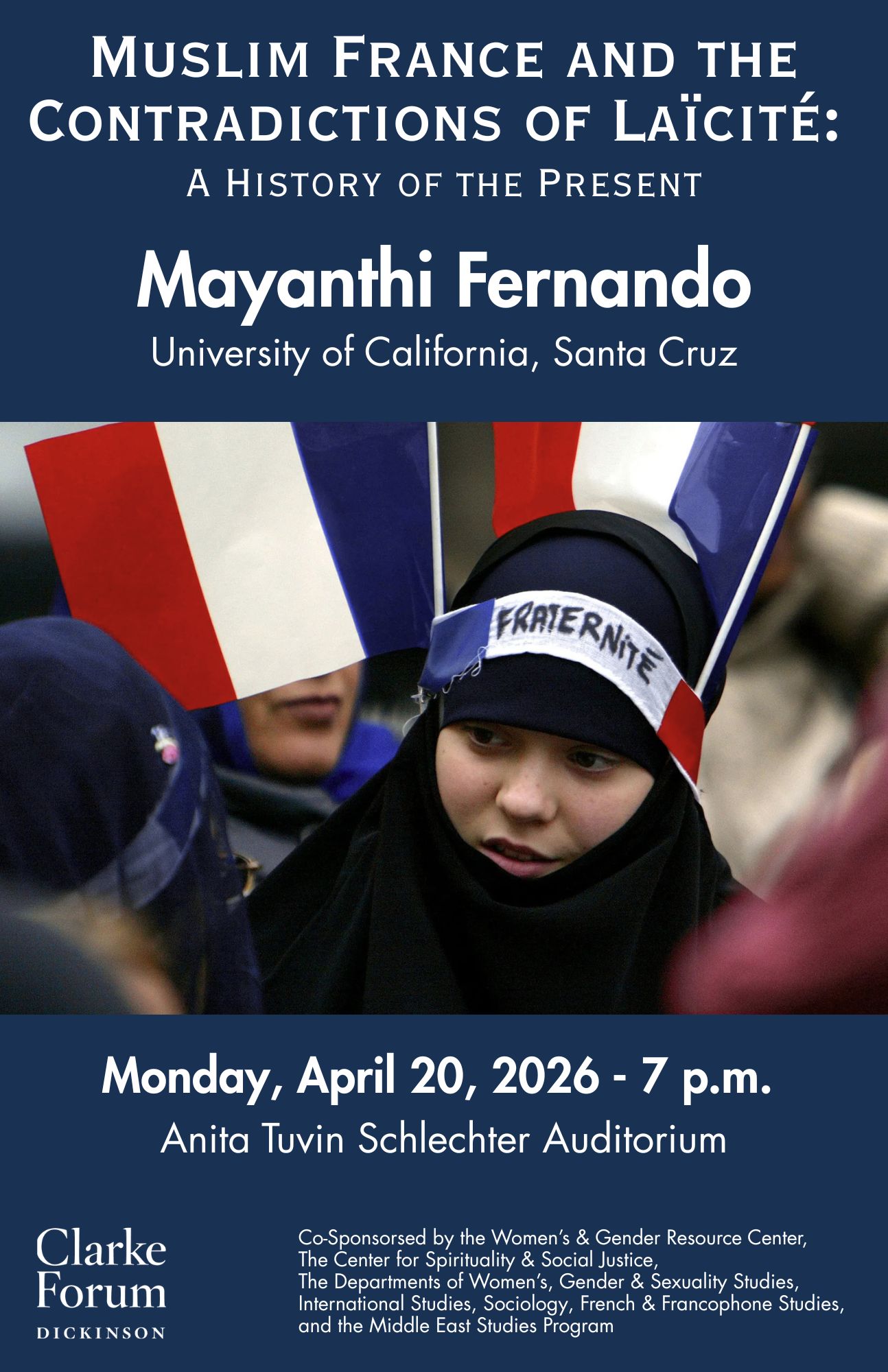
Muslim France and the Contradictions of Laïcité: A History of the Present
Mayanthi Fernando, UC Read more

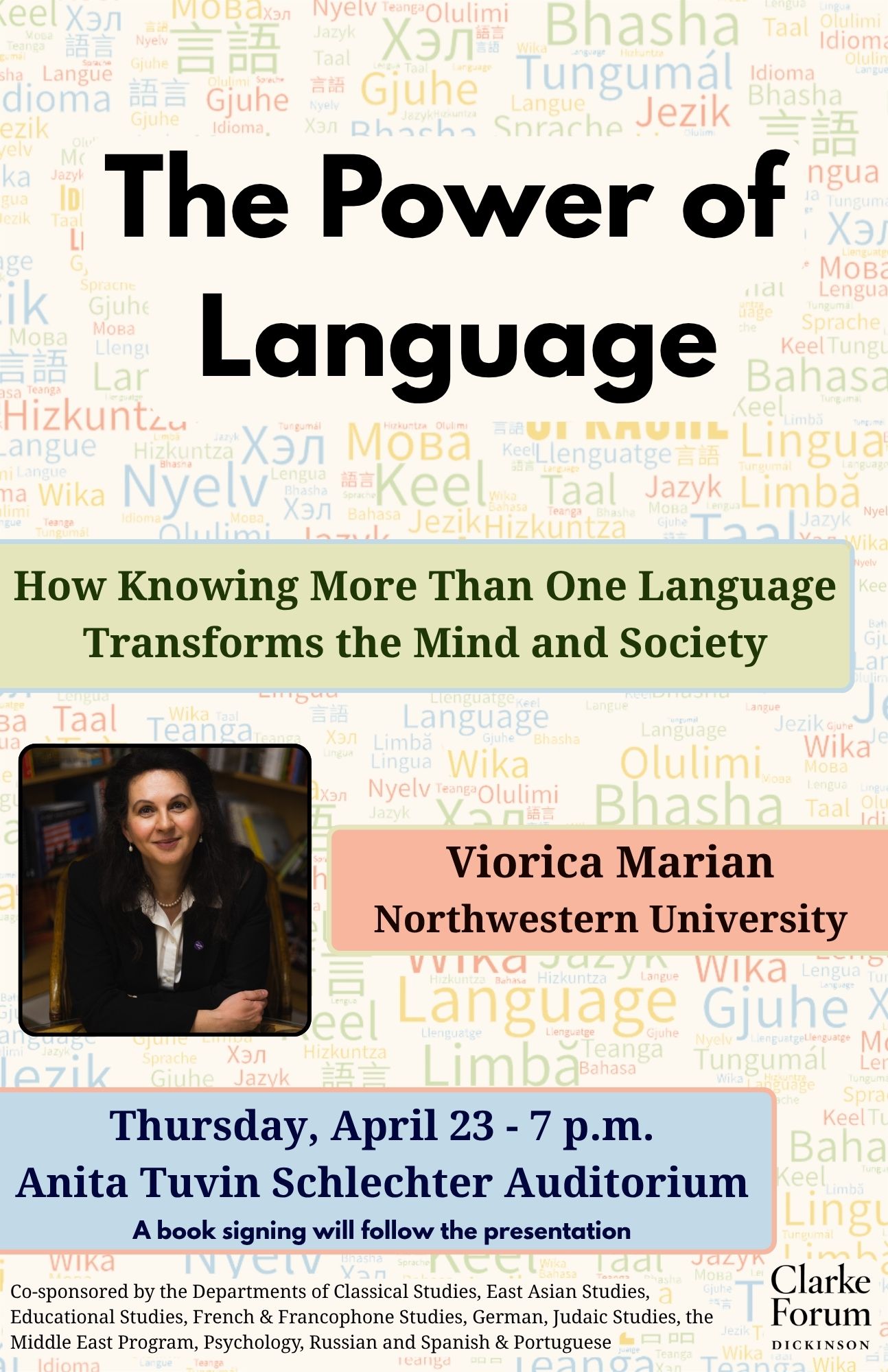
Thursday, April 23, 2026

Anita Tuvin Schlechter Auditorium, 7 p.m.

The Power of Language: How Knowing More Than One Language Transforms the Mind and Society

Viorica Marian, Sundin Endowed Professor of Communication and Psychology at Northwestern University

Bilingualism and multilingualism are the norm rather than the exception in the world. Yet historically, scientific research has focused disproportionately on monolingual speakers as the standard. For an accurate understanding of the mind, we must recognize the brain’s ability to accommodate multiple symbolic systems simultaneously as the signal, rather than the noise, in human experience.

In this talk, I will present evidence that bilingualism reshapes cognitive architecture. My research integrates behavioral, neuroimaging, cognitive, and computational methods to capture the continuous parallel activation and interaction of multiple languages in the brain and their consequences for cognitive function, from perceptual processes to higher-order thinking. Behavioral methods such as eye-tracking and mouse-tracking reveal that bilinguals’ eye movements drift toward objects whose names overlap across languages, and that hand movements and decision-making veer toward alternatives activated by another language. Neuroimaging shows that managing multiple languages is like a workout for the brain and reshapes neural connections, leading to measurable structural and functional adaptations.

The consequences are evident across the lifespan. In Read more

Monday, April 20, 2026

Anita Tuvin Schlechter Auditorium

Muslim France and the Contradictions of Laïcité: A History of the Present

Mayanthi Fernando, University of California Santa Cruz

In 1989 three Muslim schoolgirls from a Paris suburb refused to remove their Islamic headscarves in class, igniting a debate – still raging more than 30 years later – about the place of Muslims in the French Republic and within its governing framework of laïcité (secularism). The dominant narrative about laïcité, both in France and in the US media, is that in 1905, France separated church and state, and religion was restricted to the private sphere. Public Muslimness is therefore seen as contravening this longstanding arrangement of what it means to be French.

Mayanthi Fernando will complicate that narrative to offer a different history of the present. First, she will show how laïcité has entailed not the separation of religion from politics and the public sphere but rather the French state’s intervention into religious life, including defining what counts as religion, belief, practice, symbol, and so on, using a Christian framework to make those distinctions. Fernando will then delve more deeply into the headscarf drama. The language of the 2004 law banning “conspicuous religious signs” classifies the Read more

Monday, April 13, 2026

Anita Tuvin Schlechter Auditorium, 7 p.m.

The Canary in the Coal Mine: The 1951 Refugee Convention and the Collapse of the Post WW II International Order

Seyla Benhabib is the Eugene Meyer Professor of Political Science and Philosophy at Yale University Emerita and Senior Research Fellow at Columbia Law School and the Center for Contemporary Critical Thought

The 1951 Refugee Convention is one of the most important human rights documents of the post-WW II period. Like the Universal Declaration of Human Rights (on which it is based) and the Genocide Convention, both of 1948, it embodied the hopes and aspirations of a new world order. Never again would those persecuted on account of their race, religion, ethnicity, political beliefs, and social group fail to find protection and refuge in countries other than those in which such persecution occurred.

The 1951 Convention, however, from the beginning was beset with some difficulties: first, it originally excluded countries of the Global South, whether by omission or by design. To this day, India is not a signatory of the Convention because the India-Pakistan War could find no place within its framework. Likewise, the categories of “protected groups,” named in the Convention, were based on Read more

Tuesday, April 7, 2026

Anita Tuvin Schlechter Auditorium, 7 p.m.

The World As We Would Have It Be: Collective Thriving in the Timeplace of Collapse

Norma Kawelokū Wong (Collective Acceleration), Native Hawaiian and Hakka Writer/Teacher, 86th Generation Zen Master, and Political Strategist

“We know the story of the collapse. We have much less imagination of the timeplace of the other side. Thus, the far horizon story should always take place beyond the apocalyptic time when everything completely fell apart and the skies were dark for so long no one knew lightness nor blueness. It is there and then we need to practice into.” –Norma Kawelokū Wong

We are living at a moment of rapid systemic breakdown in which chaos dominates our present condition and directs our future. Instability is no longer a failure of power but its primary technique, governing through exhaustion, fear, and confusion. Against this unpredictable, disorienting, and exhaustive background, who are we, who do we evolve to become, and how do we show up in this time of collapse? How do we relate to one another and what collectives do we build? Lastly, how do we interdependently grow and lead in times of uncertainty? In this conversation between Zen Read more

Tuesday, March 31, 2026

Mathers Theatre, 7 p.m.

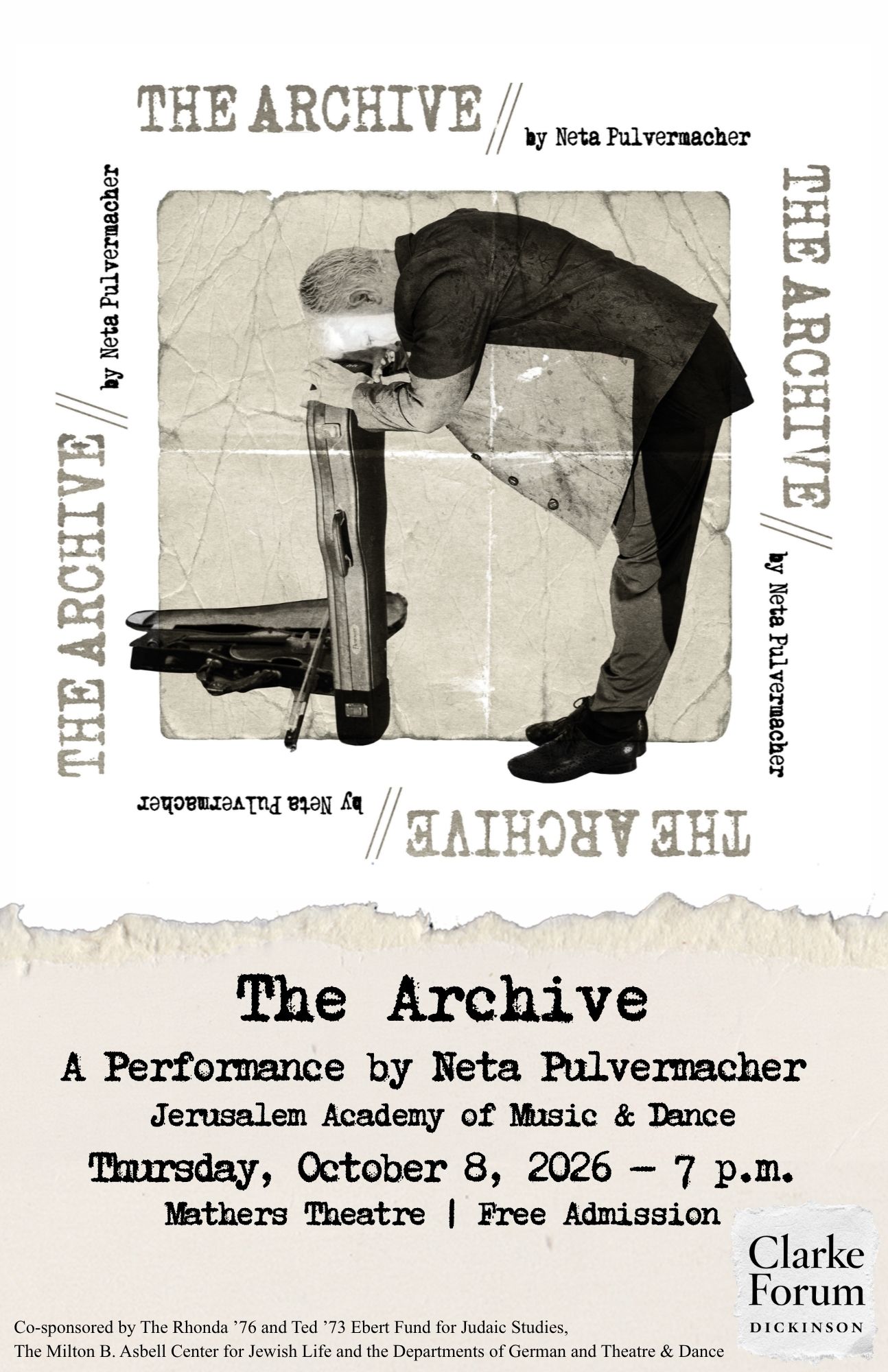
The Archive

Neta Pulvermacher, Israeli/American Choreographer, Dancer, Director and a Professor of Dance at the Jerusalem Academy of Music and Dance (JAMD)

The Archive
Created and Performed by Neta Pulvermacher

“They are not here,
And they are not coming
There is nothing here…
There is nothing here for you
It’s just this room and you and me.
And they are not here…
Go home, go home…
There’s no sense in waiting”

When the last person who remembers is gone, whole worlds disappear forever. Israeli/American artist, choreographer and performer Neta Pulvermacher, situates her riveting one woman show, The Archive, inside this perforated post-memory landscape. Exploring her German-Jewish family history, she constructs a jarring, witty and deeply moving performative journey that follows the traces to Frankfurt and Berlin – once her family’s home.

Inside a room containing a table, three chairs, a reading lamp, and an old violin, Pulvermacher sifts through documents, photographs, and personal artifacts. She dances, sings, and tells stories, conjuring fragmented narratives, voices, and characters that connect briefly only to fade away into oblivion. In her “Archive,” she asks us to consider the ephemerality of memory, history, and experience.

The Archive premiered at Villa Read more

Wednesday, March 25, 2026

Anita Tuvin Schlechter Auditorium, 7 p.m.

Finding Unity in History: Our Community Process Recovering Victims of the 1921 Tulsa Race Massacre

Phoebe R. Stubblefield, Director of the C.A. Pound Human Identification Laboratory, University of Florida

On June 1,1921, the unincorporated community of Greenwood Oklahoma was systematically looted and burned by a white mob.  The conflict derived from an attempt by the mob to lynch a young African American man, Dick Rowland, who had been accused of assaulting a white woman. Thirty-nine deaths were documented by death certificates, but the actual number of deaths is unknown due to the period of martial law which ended the rioting, poor documentation, and focus on recovery.  Twenty African American adult males were buried in the Tulsa city cemetery, Oaklawn, in unmarked graves.  In 2020 former mayor GT Bynum initiated the investigation, which continues today, to recover these and any other victims of the race massacre and return them to their families.  Our team of anthropologists have recovered over 50 individuals from unmarked graves in Oaklawn, and forensic analysis has identified six with gunshot wounds that make them potential victims of the riot.  Collaboration with our historians,  geneticists, and genealogists resulted in the first victim Read more

Sunday, March 22, 2026

Althouse Hall, Room 106 – 4:00 p.m.

Film Screening of Tulsa:  The Fire and the Forgotten

A Centennial Exploration of the 1921 Race Massacre

“A landmark PBS documentary, Tulsa: The Fire and the Forgotten examines the 1921 Tulsa Race Massacre on the 100th anniversary of the crime. The film includes interviews with descendants of the victims and probes how their families’ devastating experience affects their lives in today’s America, and also documents the current excavation of potential mass graves from the massacre. Through the historical lens of white violence and Black resistance, this project explores issues of atonement, reconciliation, and reparation in the past, present and future.” – (Description taken from the DVD Cover)

The film screening will provide historical context for this week’s program with Forensic Anthropologist Phoebe Stubblefield titled, Finding Unity in History: Our Community Process Recovering Victims of the 1921 Tulsa Race Massacre. This program is scheduled for Wednesday, March 25 at 7 p.m. in ATS.

This film screening is being presented by the Clarke Forum for Contemporary Issues. Read more

Tuesday, March 17, 2026

Poster to advertise Joshua Tucker's programAnita Tuvin Schlechter Auditorium, 7 p.m.

Bruce R. Andrews Lecture

Combating Online Harms: The Importance of Rigorous Scientific Testing of Proposed Interventions

Joshua A. Tucker is Director of the Jordan Center for Advanced Study of Russia, Co-Director of the Center for Social Media and Politics, and Professor of Politics at New York University

In the digital information era, policymakers and technology companies have implemented numerous interventions designed to mitigate online harms, ranging from misinformation to political polarization. However, Professor Joshua A. Tucker argues that we cannot rely on the assumption that these “common sense” solutions are effective; instead, they must be subjected to rigorous scientific testing. Drawing on extensive research from NYU’s Center for Social Media and Politics (csmapnyu.org), Tucker will present findings from three major studies that challenge conventional wisdom. First, he will demonstrate how the popular advice to “do your own research” via search engines can paradoxically increase belief in misinformation due to low-quality search results. Second, he will discuss the limitations of source credibility labels, which appear to have little impact on downstream news consumption or trust in media. Finally, he will review the results of the U.S. 2020 Facebook & Instagram Election Study, which Read more

Thursday, February 26, 2026

Poster to advertise Real-World Effects of AI discussionAnita Tuvin Schlechter Auditorium, 7 p.m.

Livestream Link

Real-World Effects of AI

Panelists

Hannah Beckler, Business Insider
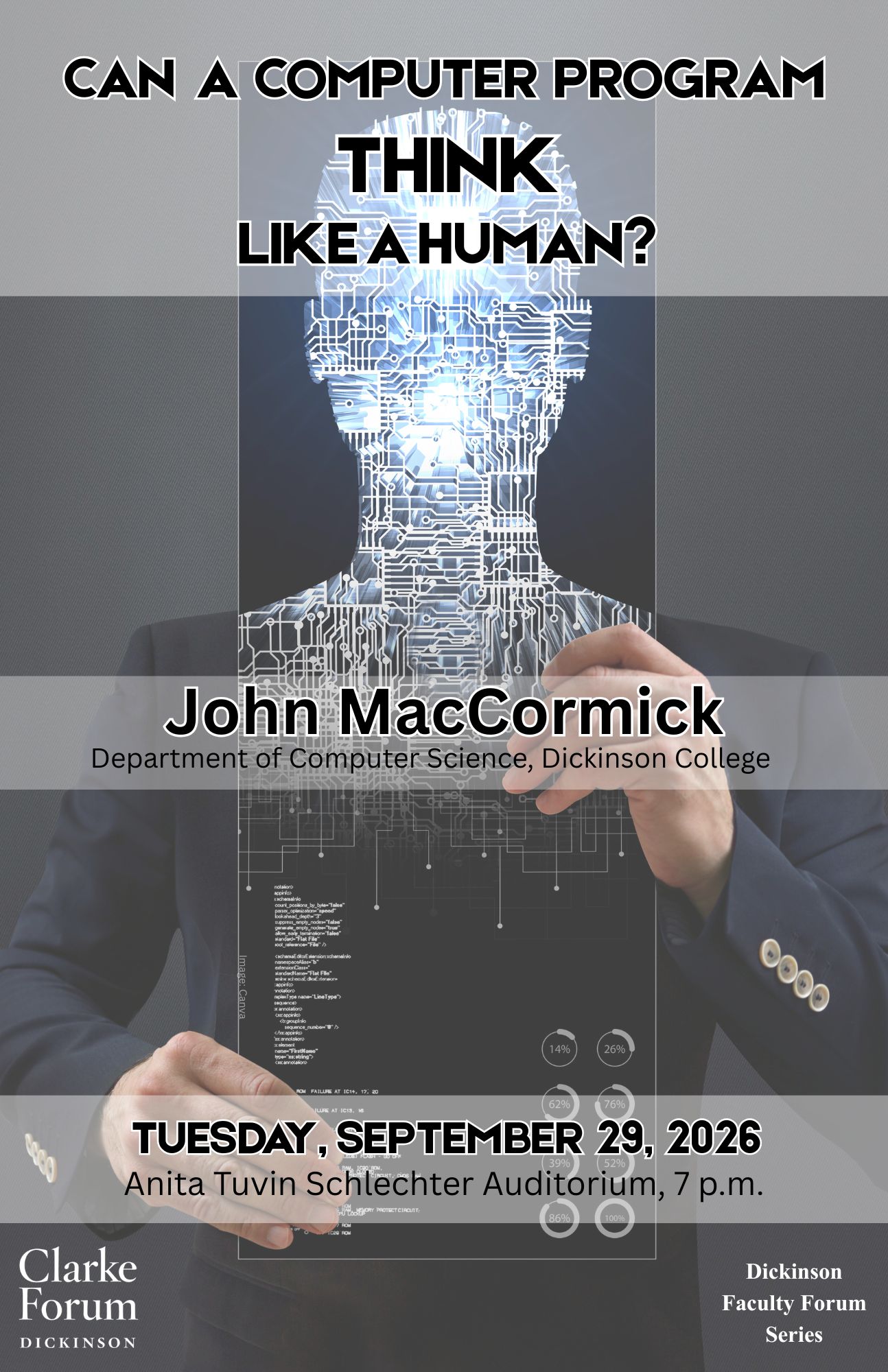
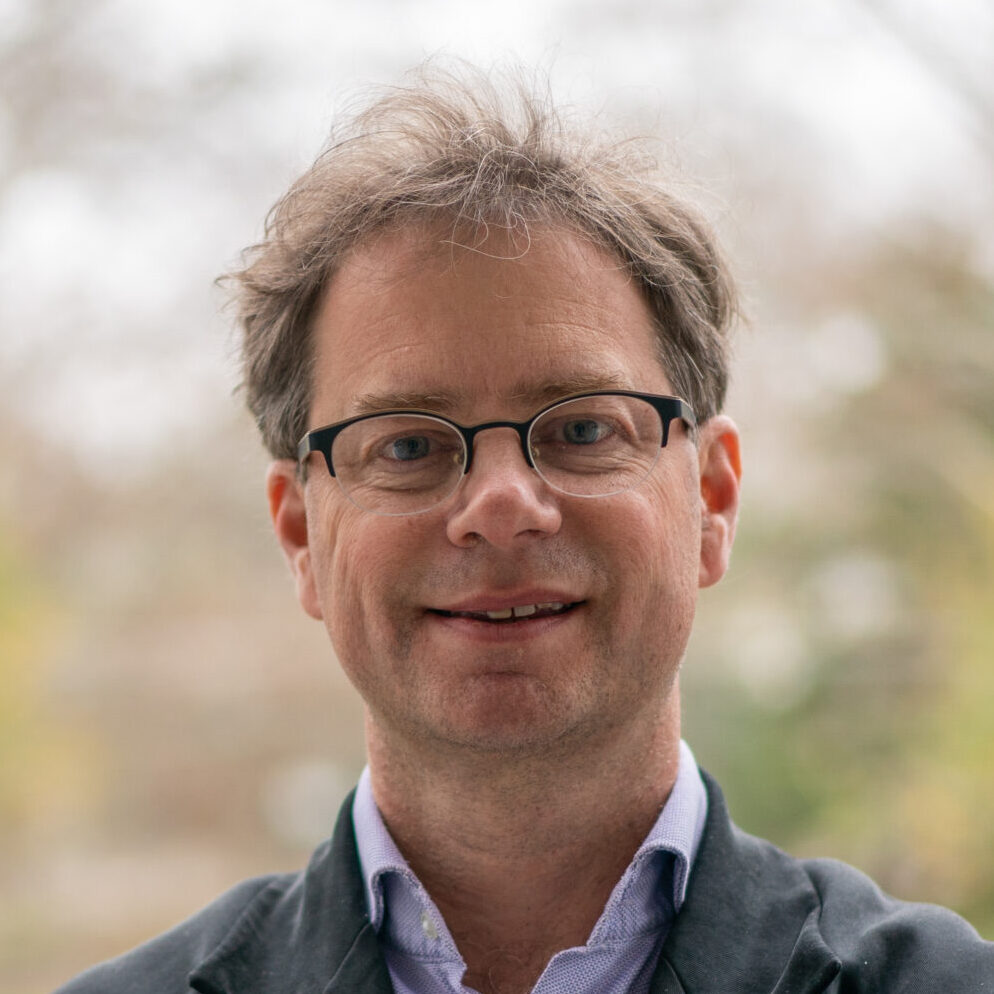
John MacCormick, Dickinson College
Amy McKiernan, Dickinson College
Fengqi You, Cornell University

Last July, the current US administration announced an action plan for “Winning the AI Race” which includes almost 100 federal policy actions, among them the dissolution of federal regulations around AI development and the promotion of rapid buildouts of data centers. This panel explores what the AI boom means for all of us, from scientific research, healthcare diagnostics and automated content creation to its effects on public utilities and the environment. The speakers will discuss different applications of generative AI and a range of ethical concerns its use poses. The panel will be moderated by Sara Markowitz, assistant director of the Clarke Forum for Contemporary Issues.

This program is presented by the Clarke Forum for Contemporary Issues and is part of the Clarke Forum’s Leadership in an Age of Uncertainty Series.

Topic overview written by Layla Ilarraza ’26.

Biographies (provided by the panelists)

Headshot of Hannah BecklerHannah Beckler is an award-winning investigative reporter at Business Insider. Her work has been honored with a National Magazine Award and the Hillman Award in Read more

Tuesday, February 17, 2026

Anita Tuvin Schlechter Auditorium, 7 p.m.

This event is in-person only. It will not be livestreamed nor recorded for future viewing. 

Phi Beta Kappa Visiting Scholar Program

The Arts, Democracy, and Public Life

Shannon Jackson is the Cyrus and Michelle Hadidi Professor of the Arts & Humanities at UC Berkeley and the Chair of the History of Art Department

How do the arts activate public life? What is the role of the arts in sustaining democracy?  In different eras and regions of the world, citizens have responded to these questions quite differently. As we mark the 250th anniversary of both the Phi Beta Kappa Society and of the United States of America, these questions have never been more resonant. The arts are key to advancing the rights of free assembly and of free expression.  The arts contribute to social movements and to the formation of civic identity.  This lecture alights upon a range of socially engaged art practices, investigating how the arts both shape and challenge our sense of community. Considering historic examples as well as those from our present moment, we will explore how public art can open us to new ideas of what democracy might mean.

This program Read more

Tuesday, February 10 & Wednesday, February 11, 2026

Tuesday, February 10, 2026
Anita Tuvin Schlechter Auditorium, 5 p.m.

Film Screening of award-winning Adiós Cuba, subtitles in English

Wednesday, February 11, 2026
Anita Tuvin Schlechter Auditorium, 7 p.m.

A​​cclaimed Cuban filmmaker, Rolando Diaz, will discuss the making of the film with Dickinson Professor Margaret G. Frohlich of Spanish and Portuguese Studies with Q & A to follow.

These programs are sponsored by The Griffith Fund, The Clarke Forum for Contemporary Issues, Spanish and Portuguese Studies, Film and Media Studies, Latin American, Latinx, and Caribbean Studies, Theater and Dance, Political Science, and The Center for Spirituality and Social Justice.

  Read more

Monday, February 9, 2026

Stern Center, Great Room, 5 p.m.

By the Power Vested in Me

A Book Talk by Author Michael Stambolis-Ruhstorfer ’04

In both the United States and France, each side of the legal battle over same-sex marriage and parenthood relied heavily on experts. Despite the similarity of issues, however, lawmakers in each country turned to different sets of authorities: from economists and psychoanalysts to priests and ordinary people. They even prized different types of expertise – empirical research in the United States versus abstract theory in France.

Through the story of the fight over gay rights, By the Power Vested in Me reveals how and why certain experts – but not others – obtain the authority to shape public opinion and policy. At a time of soaring public distrust in experts, this book offers new ways to understand the contested political role of expertise and its consequences.

This program is sponsored by the departments of French & Francophone studies, sociology and women’s, gender & sexuality studies, the LGBTQ+ Center and the Clarke Forum for Contemporary Issues.

Michael Stambolis-Ruhstorfer is a sociologist and associate professor of American Studies at the University of Toulouse. He is also a junior member at the Institut Read more

Tuesday, February 3, 2026

poster for Beverly Daniel Tatum's eventAnita Tuvin Schlechter Auditorium, 7 p.m.

This program was in-person and livestream only. No recording is available for viewing.

Black History Month Conversation

The Psychology of Belonging: Navigating Identity on a College Campus

Dr. Beverly Daniel Tatum, President Emerita of Spelman College, Best-Selling Author and Clinical Psychologist

Dr. Beverly Daniel Tatum—esteemed psychologist, scholar, and former president of Spelman College—joins Dickinson College for a moderated conversation inspired by her New York Times-bestselling book, “Why Are All the Black Kids Sitting Together in the Cafeteria?” And Other Conversations about Race. This dialogue will explore the psychological foundations of racial identity development and the ways in which students seek affirmation, belonging, and safety in community. Tatum will share insights into how identity formation shapes the student experience and why supportive environments are essential for student success.

As part of our Black History Month observance, this event offers a rare opportunity to engage directly with one of the nation’s leading voices in higher education. Together, we will reflect on what it means to build inclusive living and learning communities, a shared commitment that calls for both personal awareness and collective action.

Moderated by Dr. Jacquie Forbes, assistant professor of educational studies, Read more

Our Programming is Completed for the Fall 2025 Semester

Check back with us periodically to see what it is planned for Spring  2026.

While we work on our programming for the spring semester, there are a few ways to stay connected to the Clarke Forum. You can enjoy our content by viewing past programs and listening to guest interviews conducted by our talented student project managers.

You can also subscribe to our YouTube channel where our previous programs are available for viewing.

Snapshot of Spring 2026 Programming

Tuesday, February 3, 2026
Black History Month Cornerstone Program
The Psychology of Belonging: Navigating Racial Identity and Psychological Safety in Diverse Spaces
Beverly Daniel Tatum, President Emerita of Spelman College & Author

Wednesday, February 18, 2026
Democracy and the Arts
Shannon Jackson, UC Berkeley

Tuesday, March 17, 2026
Combating Online Harms: The Importance of Rigorous Scientific Testing of Proposed Interventions
Joshua A. Tucker, New York University

Monday, April 20, 2026
Muslim France and the Contradictions of Laïcité: A History of the Present
Mayanthi Fernando, UC Santa Cruz


  Read more

Thursday, November 20, 2025

Anita Tuvin Schlechter Auditorium, 7 p.m.


We Are Called to Be a Movement

Rev. Dr. William J. Barber II, President, Repairers of the Breach; Co-Chair, Poor People’s Campaign & New York Times Best-Selling Author

For years the Rev. William J. Barber II of the Poor People’s Campaign has been one of the most gifted moral fusion organizers, strategists and orators in the country. As an indispensable figure in the public policy and public theology landscape, he believes it’s time for everyone who cares about the state of our nation to heed the call and join forces to redeem the soul of America. It’s time to come together and renounce the politics of rejection, division and greed, and to lift up the common good, move up to higher ground and revive the heart of democracy. During this inspiring keynote, the Rev. Barber makes an impassioned argument with a message that could not be clearer: It’s time for change and the time needs you. A book signing will follow the presentation.

This program is presented by the Division of Diversity, Equity & Inclusion and the Clarke Forum for Contemporary Issues.

Topic overview written by Supasinee Siripun ’27

Biography (provided by the Read more

Monday, November 17, 2025 – What Constitutes Ethical Death? A Discussion on Medical Aid in Dying and the Death Penalty

Time: 5:00 – 6:30 p.m.
Location: Hartman House, 243 W. Louther Street
RSVP: By Friday, November 14, 2025 to clarkeforum@dickinson.edu. Space is limited.

Death and dying, aging and illness are natural parts of all living, human life. This is a universally understood and accepted fact. Who is permitted to end one’s life and how to end one’s life is another matter entirely. This salon will interrogate these concerns from various ethical positions, such as: What forms of dying are deemed socially acceptable or unacceptable? Should death be initiated by state institutions like hospitals and prisons? How do these institutions provide a ‘death with dignity’? What does it mean that the death penalty is not considered “cruel and unusual punishment” under the 8th Amendment, yet only eleven states have legalized medical aid in dying (MAID)? Is it logically incompatible to support the death penalty but not support MAID and vice versa? How do the intersections between medically assisted death and the death penalty complicate our ideas about how society values different lives?

This discussion will be facilitated by Ella Layton ‘26 and professor of philosophy, Amy McKiernan.

Required Materials:

  1. Watch: “Assisted Death & the Value of Life,” from CrashCourse at
Read more

Thursday, November 13, 2025

Anita Tuvin Schlechter Auditorium, 7 p.m.

Livestream Link

Muslims and the Global War on Terror: How the Racialization of Muslims Justifies the Expansion of Policing and Surveillance

Saher Selod, Director of Research for the Institute for Social Policy and Understanding

Dr. Selod will discuss her most recent co-authored book, A Global Racial Enemy: Muslims and 21st-Century Racism,  published on Polity Press in 2024. The book examines how Muslims experience racialization on a global scale. With special attention paid to the United States, China, India, and the United Kingdom, the authors examine both the unique national contexts and – crucially – the shared characteristics of anti-Muslim racism. In this presentation she will discuss how a range of counterterrorism policies, from hyper-surveillance to racialized policing, and the ensuing representation of Islam, have worked across borders to justify and institutionalize an acceptable, state-sponsored face of racism against Muslims.

This program is presented by the Clarke Forum for Contemporary Issues and co-sponsored by the departments of religion, American studies, educational studies, political science, sociology, and the Middle East Studies Program. This program is part of the Clarke Forum’s Leadership in an Age of Uncertainty Series.

Topic overview written by Maggie Maston ’28 Read more

Tuesday, November 11, 2025

Althouse Hall, Room 106 – 5 p.m.

Film Screening of King Coal

A lyrical tapestry of a place and people, King Coal meditates on the complex history and future of the coal industry, the communities it has shaped, and the myths it has created. Elaine McMillion Sheldon reshapes the boundaries of documentary filmmaking in a spectacularly beautiful and deeply moving immersion into Central Appalachia where coal is not just a resource, but a way of life. While intimately situated in the communities under the reign of King Coal, where McMillion Sheldon has lived and worked her entire life, the film transcends time and place, emphasizing the ways in which people are connected through an immersive mosaic of belonging, ritual, and imagination. Emerging from the long shadows of the coal mines, King Coal untangles the pain from the beauty and illuminates the innately human capacity for change.

This event presented by the Clarke Forum for Contemporary Issues and the Center for Sustainability Education and is part of Dickinson’s Fall Energy Transition Series. Read more