Themes

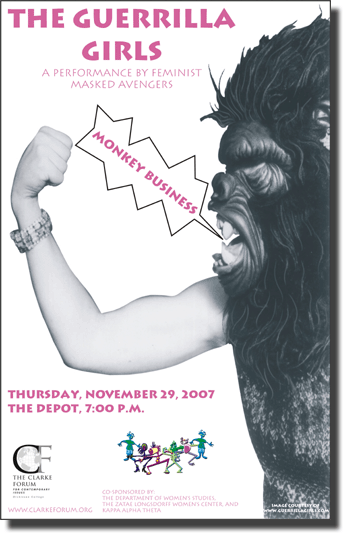
Guerrilla Girls

Monkey Business

Guerilla Girls posters
Performance
Thursday, November 29, 2007
7:00 p.m. – The Depot

The Guerrilla Girls are feminist masked avengers in the tradition of anonymous do-gooders, like Wonder Woman and Batman. They use facts, humor and outrageous visuals to expose sexism, racism and corruption in politics, art, film and pop culture. Co-sponsored by Women’s Studies and The Zatae Longsdorff Women’s Center.

Issue in Context

Sexism and racism are pervasive throughout the world of art and popular culture. Women artists and artists of color are greatly under-represented in art museums. In the National Gallery of Art, 98% of the artists displayed are male and 99.9% are white. Galleries and art collectors generally buy art from white men and when they do buy art from women or artists of color, it often ends up hidden in the gallery’s storage facility.
Women and people of color are also under-acknowledged and under-appreciated in the film industry. A female director has never won an Oscar and only three have ever been nominated. In all of the Oscars for acting, only 3% have gone to people of color.
The film and music industries continue to portray women as sexual objects or in a stereotypical fashion without depth Read more

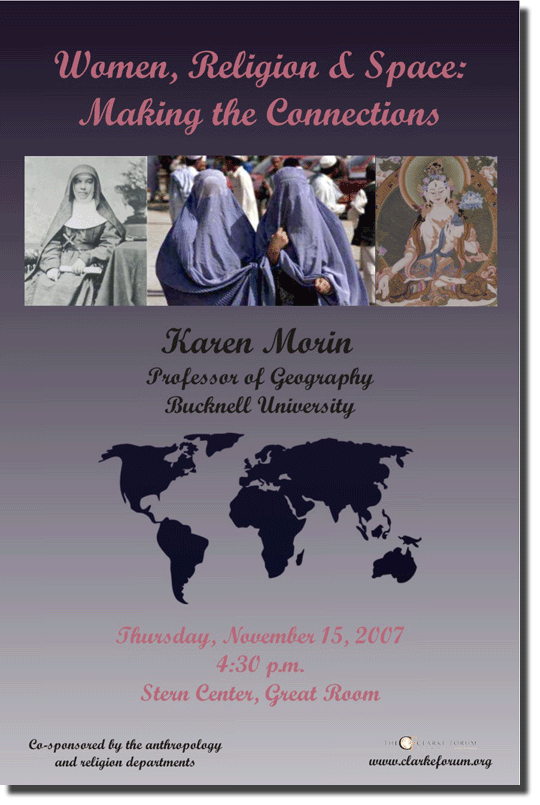
Karin Morin

Associate Professor, social/gender geography, Bucknell University.

Women, Religion and Space: Making the Connections

Karin Morin Poster
Thursday, November 15, 2007
4:30 p.m. – Stern Center, Great Room

In this talk, Karen Morin ‘triangulates’ among the scholarly domains of geography, women’s studies, and religious studies, suggesting ways to draw out the geographical implications of the study of women and religion. The talk highlights the ways that religions regulate women spatially, and how religious women negotiate and define spaces and their sense of themselves in them. Co-sponsored by the anthropology and religion departments.

Issue in Context
In the 17th century, Medieval Roman Catholic nuns benefited from the mobility of being allowed to work outside of their convents and within their communities, and of participating in missionary activities. However, in 1662, laws were passed in accordance with the Counter-Reformation that restricted the nun’s movement and often imprisoned them to their cloisters. The construction of gates and high walls around convents, the grills used to separate the nuns from the laypeople, and the use of the turntable to receive goods were just some of the limitations imposed on their lives. Nuns no longer had the right to play an active part in the church or in the Read more

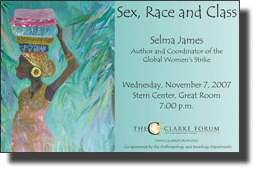
Selma James

Wednesday, November 7, 2007Selma James Poster
7:00 p.m. – Stern Center, Great Room

Sex, Race and Class

Selma James, activist, author strategist. How can we defeat sexism, racism, and other violent destructive power relations among us all internationally? What are the economic connections and what do they have to do with class? A development of Sex, Race & Class, her classic of the anti-racist women’s movement. Co-sponsored by the anthropology and sociology departments.

Issue in Context
Should women be paid for their housework duties? According to the United Nations, women do two-thirds of the world’s total labor, from raising children to working in hospitals, yet they only receive five percent of the world’s assets. In a recent interview, Selma James explained that women are working even harder today than in the past, “Women are the carers, the nurturers, put the food on the table, make sure that shirts are clean for the next day, keep the children alive and have them lined up when the men come home. But still their work is not included in the GNP (gross national product). It still doesn’t count.” As the Coordinator of Global Women’s Strike, James continues to struggle for the recognition of women’s lives Read more

Lisa Sherman ’79

Metzger-Conway Fellow, Senior Vice President and General Manager of Logo TV.
Tuesday, October 30, 2007Sherman poster
7:00 p.m. – Stern Center, Great Room

Changing Hearts and Minds: Media as a Bridge Builder for LGBT America

For the past several decades, the media has been an important and powerful tool for humanizing LGBT Americans, gradually replacing stereotypes and caricatures with authentic portrayals and depictions of LGBT people characters. In the past several years, media specifically for the LGBT audience has come to the forefront, notably with the launch of Logo, the new 24/7 ad-supported television and broadband channel from MTV networks. Lisa Sherman will discuss gays and lesbians in the media as well as the context for Logo’s place in the media landscape and how it is helping to advance a sense of an electronic community for many LGBT Americans. Co-sponsored by the psychology department.

Issue in Context

Gay, lesbian, bisexual and transgendered people are frequently excluded and misrepresented. Gay men are often represented as overly ‘feminine,’ while lesbian women are depicted as ‘masculine.’ LGBTs are also classified as excessively sexual, and it is assumed that they will make advances towards all members of the sex to which they are attracted. Such Read more

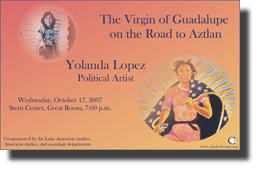
Yolanda Lopez, political artist

The Virgin of Guadalupe on the Road to Aztlan

Yolanda Lopez poster

Wednesday, October 17, 2007
7:00 p.m. – Stern Center, Great Room

Artist-provocateur and activist, Yolanda Lopez, will discuss the trajectory of her work, including her famous “virgin of guadalupe” paintings, in the context of her experiences with the Chicano civil rights movement, feminism, and contemporary immigration debates. Co-sponsored by Latin American Studies, American Studies and sociology Department.

Issue in Context
The Virgin of Guadalupe is one of the most revered Roman Catholic symbols in Mexico. She is believed to be an apparition of the Virgin Mary. From the time of the Mexican War of Independence, the Virgin of Guadalupe has been assumed as an icon of Mexican culture. Each year on December 12, millions of Mexicans and Mexican Americans celebrate The Queen of Mexico with dancing, songs, fireworks, and prayers.

According to the United States Census Bureau, in 2000 there were more than 20 million Mexican Americans living in the United States. Although they represent a large portion of the U.S. population, Chicanos, or Mexican-Americans, still often find themselves marginalized and discriminated against in mainstream society. The Chicano movement addresses negative representations of Mexican-Americans. Activists in the Chicano movement have worked Read more

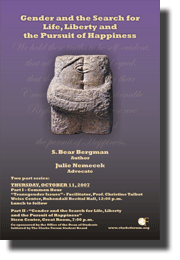
Julie Nemecek and Bear Bergman

Gender and the Search for Life, Liberty, and the Pursuit of Happiness

Thursday, October 11, 2007
Gender Poster
Part I – Common Hour
“Transgender Issues” – Facilitator, Prof. Christine Talbot
12:00 p.m. – Weiss Center, Rubendall Recital Hall

Part II – “Gender and the Search for Life, Liberty and the Pursuit of Happiness”
7:00 p.m. – Stern Center, Great Room

Julie Nemecek, consultant, former associate professor and minister and S. Bear Bergman, writer, activist, performer, will use their own compelling stories and current research to discuss the barriers gender causes for the realization of the “unalienable rights” enumerated in our country’s Declaration of Independence. They will also identify key tools and actions needed to overcome those barriers. The Clarke Forum Student Board has created this program. Co-sponsored by the Office of the Dean of Students.

Issue in Context
In an article published in the September issue of the Human Relations journal, professors Stephen Linstead and Alison Pullen define “transgender” as a gender identity that goes beyond the normative binary system of male and female social representation. By this definition, transgender does not refer to sexual orientation and transgendered people may identify as heterosexual, homosexual, bisexual, or asexual. The American Psychological Association specifies Read more

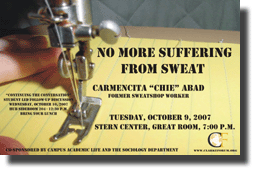
Carmencita "Chie" Abad

No More Suffering From Sweat

Tuesday, October 9, 2007ChieAbadPoster
7:00 p.m. – Stern Center, Great Room

Chie will discuss the horrible working conditions she endured in the U.S. territory of Saipan while making clothing for the Gap. In her struggle to unionize workers, she was forced to leave the island and is now working to educate Americans about inhumane factory conditions worldwide. Co-sponsored by campus academic life (first year seminars/learning communities) and the sociology department.

Issue in Context
Where did you buy the clothes you are wearing today? It is possible your clothes were made in a garment factory by underpaid women and children working in deplorable conditions. In many garment and clothing factories around the world, workers spend prolonged periods of time in dangerous settings, pressured to meet production quotas. Corporations use these “sweatshops” in their production process in order to capitalize on cheap labor costs, boost production, and pursue increased profits at the expense of the human rights and dignity of the human beings who sweat to assemble products for mass consumption.

While some limited progress has been made in establishing regulations and worker rights in some factories, a large percentage remain outside the sphere of global attention. Read more

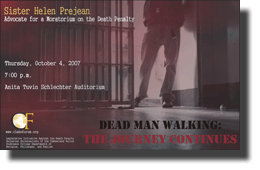
Sister Helen Prejean

Dead Man Walking: The Journey Continues

Sr. Helen Prejean poster
Thursday, October 4, 2007
7:00 p.m. – Anita Tuvin Schlechter Auditorium

Sister Helen Prejean, author of Dead Man Walking and Death of Innocents: Wrongful Executions. Sister Helen is a Southern storyteller who brings you on a journey and shares her experiences involved with her death penalty ministry while working with the poor. She is the author of Dead Man Walking and Death of Innocents: Wrongful Executions. Book signing to follow. Co-sponsored by The Legislative Initiative Against the Death Penalty, Unitarian Universalists of the Cumberland Valley, community service and religious life, and the religion, philosophy, and English departments.

Join us for a student-led discussion “Continuing the Conversation” to be held on Friday, October 5, 12:30 p.m. at The Clarke Forum. Bring a bag lunch.

Issue in Context
Since 1976, there have been 1,095 executions in the United States. The death penalty has been used as a form of punishment in America since the founding of the colonies as Europeans brought the practice with them to the New World. The methods of execution have evolved over the years from hanging, to the firing squad, the electric chair in 1890, the gas chamber in 1924, and Read more

Admiral Dennis Blair

Omar Bradley ChairBlair poster
Tuesday, September 18, 2007
7:00 p.m. – Stern Center, Great Room

The American Use of Military Force Since the Fall of the Berlin Wall

When the Berlin Wall came down in 1989 there were hopes for a peaceful new world order and even predictions of the end of history. As it turned out, the United States has sent major military forces into action nine times in the 19 years since then. Two major conflicts are continuing today in Afghanistan and Iraq. Admiral Blair will address how the United States has used military force in recent years, successfully and unsuccessfully, and how to think about what the country should do in Afghanistan and Iraq. Co-sponsored by the department of political science.

Issue in Context
The fall of the Berlin Wall in 1989 marked the end of nearly a half-century of Cold War between the United States and the Soviet Union. The United States emerged victorious, affirming its superiority in the international arena. President H. W. Bush declared grand expectations for a “new world order” – the United States would finally be able to fulfill its founding fathers’ visions of freedom. There were widespread hopes for global peace. However, Read more

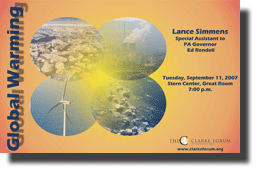
Lance Simmens

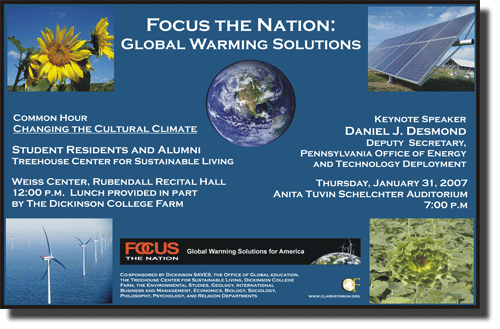
Global Warming

Tuesday, September 11
Stern Center, Great Room, 7:00 p.m.
091107Simmens

The scientific evidence on global warming is as disturbing as it is definitive. Increasing carbon emissions challenge our planet and all who inhabit it, a challenge that is here and now and that we must both acknowledge and address. Taking off from the documentary film, An Inconvenient Truth, the presentation by Simmens, special assistant to Pennsylvania Governor Ed Rendell, speaks to the average citizen.

Issue in Context
Global warming refers to the rise of the average temperature of the earth’s atmosphere and oceans and has become a prominent global issue over the last fifty years. Greenhouse gases in the atmosphere have been found by scientists to contribute in large part to the continued increase of the earth’s temperature. While some greenhouse gases are necessary to maintain a temperature suitable for life on earth, an excess of these gases can create serious problems. In the past decade, the earth has experienced some of the warmest years ever recorded. While changes in the sun’s orbit and some volcanic eruptions have contributed to global warming, scientists and environmentalists have found that the recent elevated temperatures of the planet can be attributed Read more

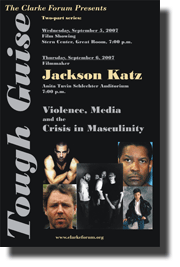
Jackson Katz, educator and filmmaker

Tough Guise: Violence, Media and the Crisis in Masculinity

Thursday, September 6
7:30 p.m. – Anita Tuvin Schlechter Auditorium
090607Katz
Mr. Katz explores the relationship between the social construction of masculinity and the widespread violence in American society, including the tragic shootings at Virginia Tech, Columbine, and elsewhere. Katz will provide the audience with conceptual and practical tools for reading both negative and positive media images critically, especially those connected with masculinity and violence. Co-sponsored by the sociology and anthropology departments.

Issue in Context
The past fifty years have seen serious challenges to conventional gender and sexual relations, which have reshaped people’s identities and experiences in the United States. Diversity has become more than just a statement of gender, racial, and ethnic uniqueness. People are embracing the idea of gender equality and more women are assuming positions of power and responsibility that transcend the domestic realm. Discriminated groups have been demanding their rights and claiming acceptance and visibility in society. These social movements are perceived as a threat by some men who react violently to the challenge of their dominant role. Jackson Katz points that the only field in which men still have an advantage over women is the “area of Read more

"Tough Guise: Violence, Media, and the Crisis in Masculinity" – Film Showing

Wednesday, September 5
7:00 p.m. – Stern Center, Great Room
The first educational video to systematically examine the relationship between pop-cultural imagery and the social construction of masculine identities in the United States at the dawn of the 21st century.
Jackson Katz, educator and filmmaker will present a lecture on Thursday, September 6. Click here for more information about this lecture.
For a film clip, visit http://www.mediaed.org/videos/MediaGenderAndDiversity/ToughGuise/# Read more

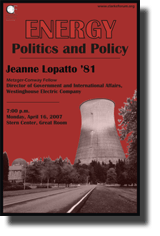
Energy Politics and Policy

Monday, April 16, 2007Lopatto Poster
7:00 p.m. – Stern Center, Great Room
Metzger-Conway Fellow
Jeanne Lopatto, director of Government and International Affairs at Westinghouse Electric Company

Ms. Lopatto advises the chairman on international policy issues and programs related to regulatory assistance to foreign countries for nuclear safety and radiation protection, non-proliferation activities, and export licensing. She also acts as liaison for the chairman’s office and other federal agencies including the Departments of Energy, State, Homeland Security, and others. She will provide an energy perspective from inside “The Beltway.” Read more

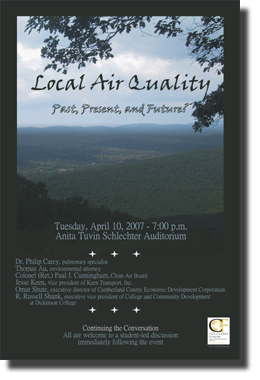
Local Air Quality: Past, Present & Future?

Air Quality Poster
Tuesday, April 10, 2007
7:00 p.m. – Anita Tuvin Schlechter Auditorium

“Continuing the Conversation”
All are welcome to stay for The Clarke Forum’s student led follow-up discussion immediately following the presentation.

Philip Carey, M.D., pulmonary specialist
Thomas Au, environmental attorney
Colonel (Ret.) Paul J. Cunningham, Clean Air Board
Omar Shute, executive director, Cumberland County Economic Development Corporation
Jesse Keen, vice president, Keen Transport, Inc.
R. Russell Shunk, executive vice president of College/Community Development at Dickinson College, Moderator

Issue in Context
Since human occupation, the Cumberland Valley has been a crossroads of commerce, trade, and travel. American Indians traversed trails through the region, along waterways and over mountains. People crossing these waterways and mountains now rely on the area’s heavy network of interstate highways. A vast logistics industry provides jobs in an economy that continues to lose manufacturing and farming. The trucks that drive through campus on Route 11 are just a slice of this network, and local air quality has diminished because of the diesel fuel emissions. A recent study by the American Lung Association indicated that the Harrisburg-Carlisle-Lebanon area has the 24th most polluted air in the nation, a factor that affects health Read more

Getting to Green?: Pennsylvania's Commitment to Renewable Energy

Thursday, March 29, 2007RushPoster07
7:00 p.m. – Stern Center, Great Room

Mike Ewall, director, ActionPA
Tom Tuffey, director, Citizens for Pennsylvania’s
Future Center for Energy, Enterprise and the Environment
Michael Heiman, facilitator, geographer and professor of environmental studies, Dickinson College

A discussion of Pennsylvania’s electricity provision, reform and contribution to global greenhouse gas emissions. Panelists will discuss the alternatives state laws allow, and the advances that have been made in wind and solar energy. An open discussion will follow.

Issue in Context
As both a major industrial state and a large producer of coal, Pennsylvania leaves a significant environmental footprint. Ranked third highest in the nation for production of greenhouse gasses (behind California and Texas), Pennsylvania contributes 1 PERCENT of all human-generated global carbon dioxide. Yet recently, this hotbed of energy generation and use has also given a lot of attention to alternative energy sources and environmental protection.
Although most agree that renewable energy sources are necessary to reduce our dependence on foreign sources and the carbon footprint accompanying fossil fuels, funding and support for alternative energy sources, some of which are less than “renewable,” is controversial in the Pennsylvania legislature and across the country. In Pennsylvania, Read more

Addressing Climate Change: A Least-Cost Strategy

Thursday, March 22, 2007
7:00 p.m. – Stern Center, Great Room
Benjamin Rush Award
Roger W. Sant

Roger W. Sant is co-founder and chairman emeritus of The AES Corporation, one of the world’s largest global power companies operating in 27 countries. Mr. Sant was assistant administrator for energy conservation and the environment at the Federal Energy Administration as well as director of the energy productivity center, affiliated with the Carnegie Mellon University.

Issue in Context
Over the past two centuries, “greenhouse gases” which trap heat in our atmosphere have caused global temperatures to increase. The concentration of “greenhouse gases” is formed from deforestation and the burning of fossil fuels. “Greenhouse gases” are critical to life for they allow the planet to remain warm. In recent years these temperatures have risen above traditional levels, providing cause for concern. Eleven out of the past 12 years have been some of the warmest years ever recorded. Levels of carbon dioxide in the atmosphere are 30 percent higher than they were during the Industrial Revolution. Polar ice caps are melting rapidly, at an average of 9 percent per decade; artic thickness has decreased 40 percent in the past 40 years. Furthermore, the number of Read more

The Interaction of Regulation, Markets, and Technology: Consumer Empowerment in the Electric Power Industry

Tuesday, February 27, 2007
Kiesling Poster
7:00 p.m. – Stern Center, Great Room
Lynne Kiesling, senior lecturer of economics at Northwestern University and research scholar, Interdisciplinary Center for Economic Science at George Mason University

Widespread electric power was one of the most dramatic achievements of the 20th century, and throughout its life there has been great tension among regulation, markets, and technological change. This talk will explore those tensions, with specific applications to regulatory, economic, and technological change in the early 21st century. Digital technology has transformed how we live our lives in many ways, but it has not affected how customers consume power or control their energy choices. We will explore the important implications of these questions for economic efficiency and equity, and for environmental quality.

Issue in Context
One of the most striking characteristics of the 20th century were advancements in the physical sciences. One such defining accomplishment was the spread of electrical power throughout the United States. Since then constant tension between consumers, electrical companies, regulation, and technological change has existed. Electrical companies continually strain to generate the amount of power consumers demand. Due to environmental issues, the U.S. government begins to regulate the electrical companies, which, some Read more

Fiasco: The American Military Adventure in Iraq

Monday, February 26, 2007Fiasco Poster
7:00 p.m. – Anita Tuvin Schlechter Auditorium
Thomas E. Ricks, Pulitizer-prize winning journalist, The Washington Post, and author

As the title, “Fiasco” suggests, Thomas E. Ricks views the American war in Iraq as a misguided exercise in folly and incompetence. His book provides a detailed and comprehensive critique for anyone interested in understanding how the United States came to go to war in Iraq, how an insurgency emerged, and how these events will affect the future of the United States. Ricks will discuss his findings and respond to questions from the audience.
Co-sponsored by International Business & Management and Political Science

Issue in Context
As of February 19, 2007, the official U.S. death toll in Iraq was 3,133, more than ten times the fatal casualties of all other coalition countries combined. The U.S. has invested about $500 billion in the Iraq war, but several audits over the last couple of years have revealed incomplete or unreliable documentation on the spending of several billions of dollars. A recent Washington Post article revealed that nearly 100 million dollars in cash intended for rebuilding projects in south-central Iraq cannot even be accounted for.
Three years ago, it Read more

Oil, War, and Geopolitics: The Global Struggle Over Disappearing Petroleum

Thursday, February 22, 2007
Klare Poster
7:00 p.m. – Stern Center, Great Room
Michael Klare, Five Colleges professor of peace and world security studies

As we move deeper into the 21st century, the global demand for energy in all its forms is rising at breakneck speed, but the global supply is failing to keep pace, producing intensified competition between the major consuming nations — especially the United States, China, Japan, and the European powers — for access to the available supply. On top of this, the center of gravity of world energy output is moving inexorably from the Global North to the Global South, producing increased anxiety and uncertainty over the reliability and safety of international energy shipments. Both of these trends are contributing to the increased militarization of energy policy. Unless more is done to reduce our reliance on hydrocarbons, we can expect a global epidemic of “resource wars” over oil and other sources of energy.
Co-sponsored by Environmental Science, International Studies, International Business & Management, and Political Science.

Issue in Context

The actions of the U.S. in the Middle East during the past twenty years have been the subject of considerable debate. In his 2001 article “Geopolitics of War” Read more

The Neoliberal City

Thursday, February 1, 2007Neoliberal City
7:00 p.m. – Anita Tuvin Schlechter Auditorium
David Harvey, Distinguished Professor of Geography, Department of Anthropology at the Graduate Center of the City University of New York

The global economic transformations that have occurred since 1970 or so are increasingly being referred to in terms of the rise of a “neoliberal” form of political economy (privatization, the withdrawal of the state from social provision, the inculcation of an ethic of personal responsibility). The urban consequences of this transformation have been the focus of considerable attention, but the New York “fiscal crisis” of the mid 1970s and its aftermath turns out to have been an originary moment in the rise of neoliberal practices. Tracing the history of neoliberalization through the recent history of urbanization reveals much about the power structures lying behind these transformations.

Books authored by David Harvey are available at the Waidner-Spahr Library. Read more