
All posts by admin
AIDS: Lest We Forget
Liberal Arts Education, Leadership and Business Management
Ethics in Neurological Practice: Discerning Appropriate Medical Care in Cases of Severe Brain Injury and Disease

The First September 11: The Tragedy of U.S. Moral Ambivalence Toward Democracy and Torture in the "Condor Years" in Latin America
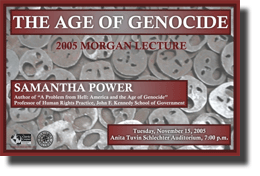
The Age of Genocide
Aquaporin Water Channels: From Atomic Structure to Clinical Medicine

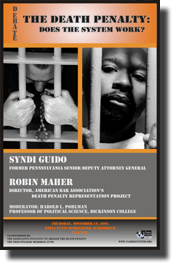
The Death Penalty: Does the System Work?
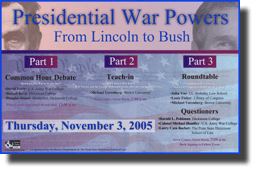
Presidential War Powers: From Lincoln to Bush
Race, Class, and Violence in America: Building Coalitions for Change

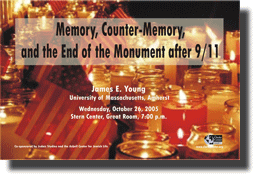
Memory, Counter-Memory, and the End of the Monument after 9/11
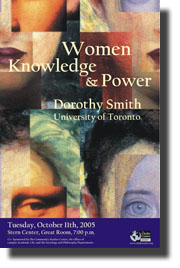
Women, Knowledge & Power
Healing: At What Price?

Open House and Reception
Monday, December 4, 2006
Open House and Reception
Please join us as we celebrate our name change from The Clarke Center to the Clarke Forum for Contemporary Issues.
249-255 W. Louther Street, Carlisle
4:00 – 6:00 p.m.
Open House and Reception
Monday, December 4, 2006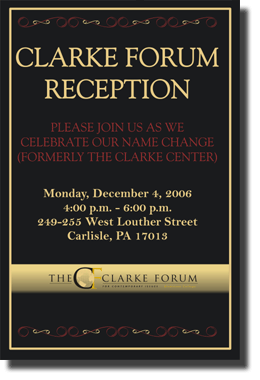
Open House and Reception
Please join us as we celebrate our name change from
The Clarke Center to The Clarke Forum for Contemporary Issues.
249-255 W. Louther Street, Carlisle
4:00 – 6:00 p.m. Read more
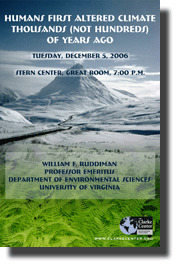
Humans First Altered Climate Thousands (Not Hundreds) of Years Ago
Tuesday, December 5, 2006
Humans First Altered Climate Thousands (Not Hundreds) of Years Ago
Stern Center, Great Room, 7:00 p.m.
Issue in Context
The earth’s climate naturally goes through periods of warming and cooling. Currently, the average temperature of the planet is increasing at an alarming rate. The most common conjecture of environmental scientists is that human actions are accelerating the natural warming of the planet. The amount of greenhouse gases, like carbon dioxide (CO 2 ) and methane (CH 4 ), present in the atmosphere has increased, due in part to human consumption of fossil fuels such as oil, coal and natural gas. Most scientists attribute this increase to the population growth and the industrialization of the past few hundred years in human history. However, William F. Ruddiman, a professor emeritus from the Department of Environmental Sciences at the University of Virginia suggests that significant human intervention in the natural operation in the climate system actually began 5,000 to 8,000 years ago. Even while the world population was relatively small, heavy deforestation and rice irrigation in Eurasia , compounded by additional emissions from an unusually warm ocean caused a shift in global climate. Ruddiman suggests that by the start Read more
Concert: Works by Beethoven, Prokofiev, Ravel, and Saraste
Sunday, November 19, 2006
Concert: Works by Beethoven, Prokofiev, Ravel, and Saraste
Weiss Center, Rubendall Recital Hall, 4:00 p.m.

Program
Ludwig Van Beethoven, Sonata No. 8, Op.30
Sergei Prokofiev, Sonata in D major, Op. 94
Intermission
Maurice Ravel, Sonata for violin and cello
About the Performers
Richard Amoroso
Violinist Richard Amoroso joined The Philadelphia Orchestra in 1998. Born in 1970 to a musical family, he is well-known for his involvement in the Philadelphia musical community and for his extensive work with young people. A former pupil of past Philadelphia Orchestra concertmasters, Norman Carol and William de Pasquale, Mr. Amoroso continues in the long and rich tradition of these artists.Recent engagements include a recital at Carnegie Hall’s Weill Recital Hall and a solo appearance with the Philly Pops Orchestra. In addition, Mr. Amoroso speaks from the stage to both subscription and young audiences of the Philadelphia Orchestra. He is also a frequent participant in the orchestra’s chamber music series and Family Concerts.
Mr. Amoroso’s relationship with The Philadelphia Orchestra began at the age of 14 when, as winner of the orchestra’s student concerto competition, he performed as soloist with the orchestra on the stage of the famed Academy of Music. He Read more
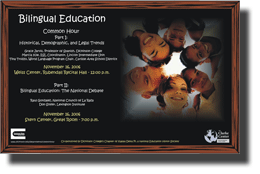
Bilingual Education Symposium
Thursday, November 16, 2006
Bilingual Education Symposium
Common Hour
Part I: Historical, Demographic and Legal Trends
Grace Jarvis, Professor of Spanish, Dickinson College
Marcia Kile, ESL Coordinator, LIU
Tina Trozzo, World Languard Program Chair, CASD
Weiss Center, Rubendall Recital Hall, 12:00 pm
Part II: The National Debate
Raul Gonzalez, National Council of La Raza
Don Soifer, Lexington Institute
Stern Center, Great Room, 7:00 pm
Issue in Context
Started in 1968 by the federal government, bilingual education programs are designed to educate students whose first language is one other than English. The goal of these programs is to help students become proficient in English and be able to succeed in mainstream classes. The nation’s schools are becoming increasingly diverse in all areas, both urban and rural, further emphasizing the need for bilingual educators. Over the last decade the number of students in the United States in need of bilingual education has increased to three million. These changing demographics are demanding more effective bilingual education programs nationwide.
The best method of bilingual education has been highly debated for years. The major issue is the extent to which the student’s native language should be used. Some educators are proponents of instruction in the Read more
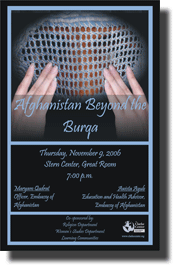
Afghanistan Beyond the Burqa
Thursday, November 9, 2006
Afghanistan Beyond the Burqa
Stern Center, Great Room, 7:00 p.m.
Issue in Context
A free and compulsory education is viewed by many as one of the most fundamental of all human rights. However, at least 125 million worldwide children are denied basic education and one in three adults remain illiterate, according to the Global Campaign for Education.
Under the Taliban, basic education declined between 1996 and 2001, causing an increased percentage of illiteracy and low rate of school attendance. School curriculum was restricted, schools were destroyed and female education was banned. The government closed all of the girls’ schools in the country and prevented female teachers from working. Some girls were secretly educated in their homes by parents and teachers, others attended underground schools. In 2000, UNICEF reported that only 4% to 5% of Afghan children were being educated at the primary school level. Fewer had access to secondary and university education. By 2001, Afghanistan possessed one of the worst educational records in the world.
Since the Taliban fell from power in 2001, international efforts led by numerous countries negotiated an aid package of $4.5 billion to help rebuild Afghanistan. More than a million attend school Read more
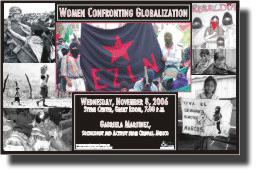
Women Confronting Globalization
Wednesday, November 8, 2006
Women Confronting Globalization
Stern Center, Great Room – 7:00 p.m.
Issue in Context
Ninety percent of Mexico ‘s potable water comes from Chiapas, but many communities have no access to fresh water. Similarly, Chiapas is Mexico’s top producer of hydroelectric energy and a major producer of natural fuels, and yet most of Chiapas ‘ indigenous people live without electricity. The Zapatistas, a largely non-violent revolutionary group struggling for the autonomy of indigenous people, has spent the last two decades raising awareness of local conditions domestically and internationally. Early in the Zapatista’s history, women joined the ranks and many rose to leadership positions, eventually creating the “Revolutionary Laws of Women,†which explicitly provided for equal rights for women in Zapatista-controlled areas. While the government has made changes in Chiapas, the region still suffers.
About the Speaker
Gabriela Martinez is a sociologist, activist, and researcher who worked with the Center of Political Analysis and Social and Economic Research in Chiapas, Mexico. Martinez has focused her studies and community work on the collective rights of indigenous communities, liberation theology, and fair trade and women’s cooperatives.
Celeste Escobar will translate for Martinez at this event. Escobar, originally from Paraguay , Read more