All posts by admin

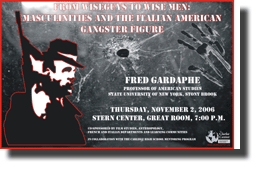
From Wiseguys to Wise Men: Masculinities and the Italian American Gangster Figure

Thursday, November 2, 2006
From Wiseguys to Wise Men: Masculinities and the Italian American Gangster Figure
Stern Center, Great Room, 7:00 p.m.
Wiseguys to Wisemen
Issue in Context
What does one associate with an Italian-American: pasta, large families, nice clothes, masculine men, and the mafia? These are some of the common stereotypes Americans have had about Italians living in the United States since they began arriving in the late 19 th century. Violence, sexism, machismo, overt sexuality and an obsession with abundance have characterized the persona of the Italian-American gangsters of yesterday in films such as The Godfather or Goodfellas. Represented as highly physical, the images of Italian men have helped construct what it meant to be an American man. The “wiseguy” character expresses both the experience of Italian immigrants and native fantasies that reveal the culture of American race, gender, and ethnicity. The wiseguy figure can be interpreted as a “trickster” character long employed as a metaphor in American literature to serve as a model of improper behavior.

About the Speaker
Fred Gardaphe is the director of the American and Italian American Studies Program at the State University of New York at Stony Brook. He teaches courses in Italian American history and Read more
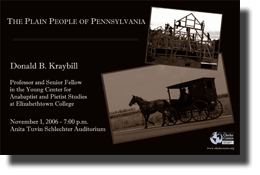
The Plain People of Pennsylvania

Wednesday, November 1, 2006
The Plain People of Pennsylvania
Anita Tuvin Schlechter Auditorium, 7:00 p.m.

Plain people

Issue in Context
Early this fall, the murder of five students in an Amish schoolhouse thrust a community and its culture into the international media spotlight and sent shockwaves through the Pennsylvania communities that had for so long coexisted with these peaceful people. Despite our vicinity to this culture, there is little understanding of these people who are known for their conservative dress and restricted use of modern technologies, such as electricity and cars.

About the Speaker
Donald B. Kraybill is Distinguished College Professor and Senior Fellow in the Young Center for Anabaptist and Pietist Studies at Elizabethtown College. Kraybill has also served as Provost at Messiah College. Nationally recognized for his scholarship on Anabaptist groups, Kraybill is the author or editor of over 18 books and dozens of professional articles. His books have been translated into six different languages. His research on Anabaptist groups has been featured in magazines, newspapers, and on radio and television programs across the United States and in many foreign countries, including Great Britain, Germany, the Netherlands, France, Australia, and Japan. He received the National Religious Book Award for The Read more

Venezuela’s PetroPolitics: Democracy over a Barrel

Monday, October 30, 2006
Venezuela’s PetroPolitics: Democracy over a Barrel
Stern Center, Great Room, 7:00 P.M.

Venezuela's Petropolitics

Issue in Context
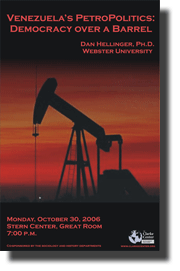
Home of the fifth largest oil industry in the world, Venezuela has gained increasing economic and political clout in the midst of a global scarcity of oil. Venezuela’s oil policy has polarized the country’s domestic politics, culminating in the 2002 coup that nearly removed its populist president, Hugo Chavez, from office. In addition to triggering intense public debate on the home front, Venezuela’s oil politics and its effects on the country’s domestic and foreign relations have alarmed governments around the world. Despite criticism from the U.S. administration and oil CEOs, Chavez has utilized his country’s oil revenues to promote his idea of democratic socialism by creating a vast array of social programs that have boosted his popularity among Venezuelans. Chavez has also allocated oil revenues to fund an aggressive diplomatic agenda. In light of an upsurge in global terrorism, oil policy in Venezuela has dramatically transformed the country’s position in the sphere of global politics, as world leaders have linked Chavez’s actions to broader questions of national security. Pat Robertson’s controversial request that the U.S. administration “take out” Chavez demonstrates the Read more

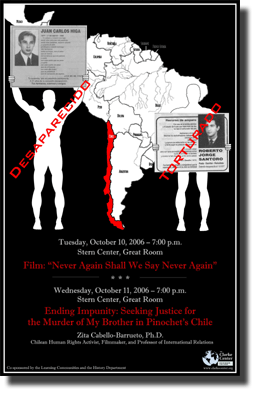
Ending Impunity: Seeking Justice for the Murder of My Brother in Pinchet's Chile

Wednesday, October 11, 2006
Ending Impunity: Seeking Justice for the Murder of My Brother in Pinochet’s Chile
Stern Center, Great Room – 7:00 p.m.

Chili Poster
Issue in Context
In the Chilean presidential election of 1970, Salvador Allende, running for the socialist-leaning coalition, Unidad Popular (Popular Unity), defeated the sitting president. He won a narrow plurality of 36.2 percent to 34.9 percent of the vote over the former president. In conjunction with members of Chile’s conservative wing, the United States government, particularly the CIA, helped engineer a coup twelve days before Allende’s inauguration. In a failed kidnaping attempt, General René Schneider, Commander in Chief of the Chilean Army, was assassinated by rightists. Ironically, this unpopular action only helped end military opposition against Allende. The president would remain ostensibly unchallenged for the next three years. On September 11, 1973, Augusto Pinochet led a bloody coup d’etat against then President Allende. The brutality of the immediate aftermath would portend the brutality of years to come. American freelance journalist Charles Horman and Chilean folk-singer Victor Jara were among the many tortured and killed in the days following the coup. Over the next month and a half, the infamous Caravan of Death, a Chilean army squad, Read more

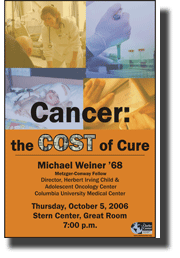
Cancer: the Cost of Cure

Thursday, October 5, 2006
Cancer: the Cost of Cure
Stern Center, Great Room, 7:00 p.m.
Cancer

Issue in Context
With medical care costs around the country soaring, it is no surprise that cancer drugs are doing the same. However the price increases of pharmaceuticals are not uniform. Express Scripts, a pharmacy benefit manager, produced a report indicating that the cost of a prescription for cancer treatment drugs rose 16% last year, while other prescription costs rose only 3%. Marcia Angell, faculty member at Harvard Medical School and former editor of The New England Journal of Medicine, suggests that these costs are “really exploiting the desperation of people with a life-threatening illness.” Yet if simply treating cancers costs this much, how much would it cost to find cures? If cures are possible, who should pay the billions it may take to find them?

About the Speaker
The speaker and Metzger-Conway Fellow, Dr. Michael Weiner, is a Dickinson College alumnus who received his medical degree from the State University of New York Health Sciences Center. After completing his postgraduate training at Montefiore Hospital and Medical Center of the Albert Einstein College of Medicine, New York University and the Johns Hopkins University Hospital, he Read more

Ethanol and Biodiesel Biofuels: Energetic and Environmental Issues

Tuesday, October 3, 2006
Ethanol and Biodiesel Biofuels: Energetic and Environmental Issues
Anita Tuvin Schlechter Auditorium, 7:30 p.m.

Ethanol and Biodiesel Biofuels
Issue in Context
Though the U.S. has less than 4% of the world’s population, it is responsible for 22% of the carbon dioxide released worldwide from the burning of fossil fuels. The release of carbon dioxide is the greatest contributor to global warming. The high energy usage of the United States makes alternative energy sources essential in reserving the pollution and dependence on fossil fuels. Ethanol, an energy source derived from corn, soybeans, and switch grass, has been touted as a clean alternative to fossil fuel. However, the production of ethanol requires a lot of energy – through farming and harvesting to deriving ethanol. The fuel used to produce it may be more than the energy it provides.

About the Speaker
David Pimentel is a professor of Ecology and Agricultural Science at Cornell University . His research includes population ecology, biological control, biotechnology, sustainable agriculture, land and water conservation, and environmental policy. Pimentel has served on many national and government committees including the National Academy of Sciences, the President’s Science Advisory Council, the U.S. Department of Energy, and the U.S. State Department. Read more

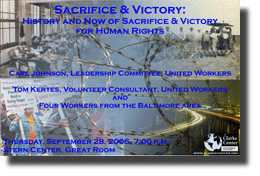
Sacrifice and Victory: The History and Now of Sacrifice and Victory for Human Rights

Thursday, September 28, 2006
Sacrifice and Victory: The History and Now of Sacrifice and Victory for Human Rights
Stern Center, Great Room, 7:00 p.m.

Sacrifice & Victory
Issue in Context
Throughout the past century, there have been many struggles and subsequent victories for human and worker rights. From the 19th century struggle to abolish slavery to the current struggles of stadium workers at Camden Yards in Baltimore, many tactics and personal sacrifices have been integral for bringing about positive change for workers. The 2005 hunger strike of the Immokalee Workers against Taco Bell with a grueling four year legal battle finally resulted in Taco Bell’s acceptance of the worker’s demands for a penny a pound increase in the price paid for tomatoes. Taco Bell also pledged to work with the workers to improve wages and working conditions for farm workers in the Florida tomato industry. Without the tireless efforts of the workers, Florida tomato pickers, who are some of America’s lowest paid workers, would still be living far below the poverty line.

At Camden Yards, Baltimore’s baseball stadium, dozens of workers never received payment for an entire month of work. While those responsible for this were fired, it was simply the latest event Read more

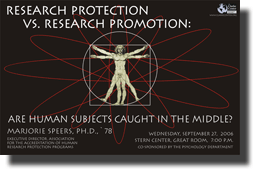
Research Protection vs. Research Promotion

Wednesday, September 27, 2006
Research Protection vs. Research Promotion
Stern Center, Great Room, 7:00 p.m.

Research Protection vs. Research Promotion

Issue in Context
The basis of all science lies in repeatable experiments that yield evidentiary results for or against a hypothesis. The only way to obtain relevant results about human response is to utilize human subjects in the experiment. However, doing experiments with human subjects instigates a deluge of complications. The demand for better regulation of human research experiments began with the Nuremburg Code after the Nazi exploitation of unconsenting prisoners of concentration camps. Now Institutional Review Boards (IRBs) carefully examine every step of the research process, from experiment design to the relevance of the potential findings to selecting human subjects. These boards, established by the US Department Health, Education and Welfare, are responsible for determining and preserving the fine line between sufficiently protecting research subjects and unnecessarily hindering research processes.

About the Speaker
Marjorie A. Speers, Ph.D is the current executive director of the Association for the Accreditation of Human Research Protection Programs (AAHRPP). From 1999 to 2001 she was acting Executive Director of the National Bioethics Advisory Commission. She also managed the development of a report on the research oversight system, “Ethical and Read more

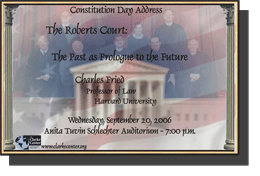
The Roberts Court: The Past as Prologue to the Future

Wednesday, September 20, 2006
The Roberts Court: The Past as Prologue to the Future
Anita Tuvin Schlechter Auditorium, 7:00 p.m.

Roberts Court
Issue in Context
Constitutional law focuses predominantly on conflicts surrounding peoples’ individual rights. The issues of abortion and gay marriage are particularly fervent disputes today. However, our Constitution affects far more than social issues. The changing politics, strategies, and technology of warfare, especially since the attacks of September 11, 2001 have greatly affected how our Constitution is interpreted, and perhaps more importantly, how the rest of the world follows this interpretation. As soldiers, or rather “enemy combatants,” are captured, situations may and have arisen in which our Constitutional rights apply to them, especially if they are citizens of the U.S. Although some believe that members of the Supreme Court should act mechanically in their interpretation of the law, the idea of a mechanical interpretation is impossible as interpretation is not based on facts. Thus, the members of the Court will always affect the decision reached.
About the Speaker
Professor Fried was born in Prague, Czechoslovakia in 1935 and became a United States citizen in 1948. He served as a law clerk to Justice John Marshall Harlan, as a special assistant Read more

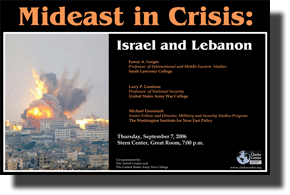
Mideast in Crisis: Israel and Lebanon

Thursday, September 7, 2006
Mideast in Crisis: Israel and Lebanon
Stern Center, Great Room, 7:00 p.m.

Mideast in Crisis
Fawaz A. Gerges, professor International and Middle Eastern Studies, Sarah Lawrence College; Larry P. Goodson, professor of Middle East studies, United States Army War College. A discussion of the recent and historical conflict between Israel and Hezbollah, its effects on Lebanon and its implications for United States policy.
Co-sponsored by the Asbell Center for Jewish Life and the United States Army War College. Read more

Mideast in Crisis: Israel and Lebanon

A panel discussion of the recent and historical conflict between Israel and Hezbollah, its effects on Lebanon and its implications for U.S. policy

Image Download mp3 audio

Image Streaming video

Panelists:
Fawaz A. Gerges, professor of International and Middle Eastern Studies, Sarah Lawrence College
Michael Eisenstadt, The Washington Institute for Near East Policy
Moderator:
Larry P. Goodson, professor of Middle East studies, United States Army War College

Co-sponsored by the Asbell Center for Jewish Life and the United States Army War College Read more

Is the European Union Constitution Dead?

Gianfranco Pasquino, professor of political science, University of Bologna

Image Streaming video (length 1:00:03)

In two successive referendums, the French and the Dutch have rejected the European Union Constitution. However, more than ten other member States have ratified, either by a parliamentary vote or through a referendum, the same Constitution. Therefore, it would be inappropriate to say that the European Union has come to a standstill. On the other hand, it would be as much foolish to deny that major institutional and political problems have come to the surface. Which are the problems and which are the solutions being entertained? Will the European Union be again, and how soon, in the position to proceed to a deeper unification? Read more

Teaching 9/11: The Role of Media, Museums and Schools in the Construction of our National Memory

How the nation’s memory of 9-11 is being created through cultural institutions.

James Fallows (Atlantic Monthly), Ron Simon (Museum of Television and Radio), Fiona Spruill (NYTimes.com), Marvin Kalb (Center on the Press, Politics and Public Policy at Harvard University’s Kennedy School of Government).

ImageStreaming video

length: 1:43:53
(Sept 9, 2004 – Dickinson College. Co-sponsored by Dickinson College and the Smithsonian’s National Museum of American History) Read more

"The Way We Never Were: American Families and the Nostalgia Trap."

Scholar and author Stephanie Coontz explores the myths of traditional marriage.

Image Download Audio (length: 43:50)

Image Download Video

Image Streaming video

Coontz is a faculty member at Evergreen State College in Olympia, Wash., and the director of research and public education for the Council on Contemporary Families. She has published extensively on the topic of marriage and family life and is the author of several highly praised books, such as The Way We Never Were: American Families and the Nostalgia Trap and Marriage, A History: From Obedience to Intimacy, or How Love Conquered Marriage. Read more

Presidential War Powers

John Yoo, Louis Fisher and Michael Vorenberg in a panel discussion

Image Streaming video (length 1:30:18)

Panelists:
John Yoo is former deputy assistant attorney general in the Office of Legal Counsil of the U.S. Dept of Justice and professor of law at the University of California at Berkeley
Louis Fisher is Senior Specialist in Separation of Powers for the Congressional Research Service of the Library of Congress
Michael Vorenberg is author of Final Freedom and professor of history at Brown University Read more

Globalization, Religion and Politics

James Gelvin, Professor of Middle East history at UCLA

Image Streaming video (length 1:07:54)

Islamist movements trumpeted the same commitment to social justice and social welfare as had governments before the 1970s. That commitment still resonated with the inhabitants of the region. Their own populist credentials in tatters, states throughout the region answered those who challenged them with repression. In the case of Iran, this did not work. In 1978-9, a broad-based revolutionary movement overthrew the shah. In other cases, repression has provided what may prove to be only temporary relief. It is a bit ironic that in the post-cold War “Age of Democratization” and “Age of Globalization,” so much of the Middle Eastern population has thus found itself enmeshed in the twin snares of authoritarianism and economic stagnation. Read more

The Making of Memories

Thursday, March 27, 2006
Common Hour
The Making of Memories
Weiss Center, Rubendall Recital Hall, 12:00 p.m.

Issue in Context
Memory is an essential quality of being human. Our individual and collective sense of identity depends on the workings of memory. Until recently, memory was studied largely as an aspect of philosophy. Modern technological advances make it possible for neurologists to examine memory’s biological operations, including long-term potentiation, (LTP). LTP occurs when one nerve cell stimulated by another, remembers the stimulation, and forms a cellular bond. This transformation of the nerve cell is essential to the storage of memory. The brain contains over 100 billion nerve cells, each with thousands of synapses. Whenever a memory is formed, some of these synapses change. As they are continually stimulated their surfaces are permanently altered forming connection points with other nerve cells. These contact points are the foundation for the contact and chemical alterations in the nerve cells that serve as memory units.

Cultural memory is a facet of every society. It is passed down collectively through generations, preserved in forms such as theatre, arts, literature, music and ritual. As an illustration of cultural memory, this event presents music and text from a Read more

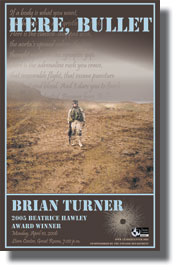
Here, Bullet

Monday, April 10, 2006
Here, Bullet
Stern Center, Great Room, 7:00 p.m.

Here Bullet
Issue in Context
A majority of the poems in Here, Bullet were written during Turner’s one-year tour in Iraq and reflect the struggle to understand his place in the War and the world. This first-hand account of the War in Iraq stands as a powerful witness to the actual events of the War. The poems are neither politically skewed nor do they make moral assumptions. Instead, they leave the reader to draw conclusions and feel the poetry.

The first and only of Brian Turner’s published books to date, Here, Bullet has garnered national acclaim. Both author and poetry have been featured in many publications and radio broadcasts, including Maine Things Considered and NPR. Here, Bullet is the recipient of the 2005 Alice James Books’ Beatrice Hawley Award.

Reviews of Here, Bullet

• “The day of the first moonwalk, my father’s college literature professor told his class, ‘Someday they’ll send a poet, and we’ll find out what it’s really like.’ Turner has sent back a dispatch from a place arguably more incomprehensible than the moon—the war in Iraq —and deserves our thanks…”
– The New York Times Book Review Read more

Lincoln and Civil Liberties in the Light of 9/11

Thursday, March 30, 2006
Lincoln and Civil Liberties in the Light of 9/11
Stern Center, Great Room, 7:00 PM

Issue in Context
Throughout American history, the United States government has restricted certain civil liberties for the sake of national security in response to national crises. In light of the terrorist attacks of September 11, 2001, the problem of balancing national security with civil liberties has resurfaced as a widely debated issue in American politics. Political conflict inevitably ensues when governments increase security measures at the expense of personal freedoms. Such was the case during the Civil War when President Abraham Lincoln suspended habeas corpus to imprison and exile Confederate sympathizers whom he deemed detrimental to the Union and the future of the country. Many argue that President Lincoln’s actions during the Civil War should serve as an instructive precedent for America in a post 9/11 world. As the nation is currently immersed in the war on terror, the American government is attempting once again to balance the civil liberties Americans have traditionally enjoyed with deadly threats from terrorist networks around the globe. The terrorist attacks of 9/11 have not only changed Americans’ present views concerning civil liberties and security, but Read more