Past Programs

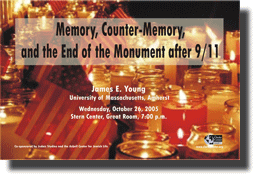
Memory, Counter-Memory, and the End of the Monument after 9/11

Wednesday, October 26, 2005
Memory, Counter-Memory, and the End of the Monument after 9/11
Stern Center, Great Room, 7:00 p.m.

memorial-poster.gif

Issue in Context
Constructing monuments to commemorate tragedies such as the Holocaust and 9/11 can trigger intense debate as designers strive to represent the collective memory of a grieving nation. Much of the controversy stems from the aesthetic and political dilemmas involved in creating national monuments. The United States and Germany recently faced such predicaments while constructing the World Trade Center Site Memorial in New York City and the National Holocaust Memorial in Berlin . The memorials in both countries strive to convey the full spectrum of citizens’ sentiments, but each monument has received criticism for falling short. Since historical events are open to so many interpretations, one wonders if it is possible to construct a monument that captures the full range of emotion and memory.

About the Speaker
James E. Young is a renowned scholar of Holocaust remembrance and an internationally recognized expert on memorial architecture. He was appointed to the selection committees for both the National Holocaust Memorial in Berlin and the World Trade Center Site Memorial in New York City .

Young has written numerous articles concerning Read more

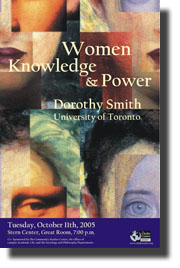
Women, Knowledge & Power

Tuesday, October 11, 2005
Women, Knowledge & Power
Stern Center, Great Room 7:00 P.M.

womenposter.jpg

Issue in Context
In 1833, Oberlin College became the first co-educational college in the United States. The 19th Amendment, giving women the right to vote, was ratified in 1920 and Congress passed the Equal Employment Opportunity Act in 1972. In 1981, Sandra Day O’Connor became the first woman appointed to the U.S. Supreme Court.

The word “feminist” first appeared in the 19th century and the modern feminist movement took off with passion in the 1960s. Yet, though the twentieth century saw a wave of progress in achieving women’s rights, many believe that women still have obstacles to overcome.

Dorothy Smith has argued forcefully that some of those obstacles lie squarely within the academy and in the nature of scholarly work and scientific research. In particular, Smith contends that commonly accepted social science models are problematic for women, and indeed for everyone, because women’s experience did not play a role in their development. Though women have made tremendous strides in the field of sociology over the past century, Smith believes that sociology (and more generally the social sciences) remains dominated by a male perspective and ideology. Thus, Read more

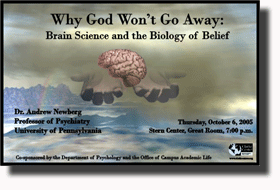
Why God Won’t Go Away: Brain Science and the Biology of Belief

Thursday , October 6, 2005
Why God Won’t Go Away: Brain Science and the Biology of Belief
Stern Center, Great Room 7:00 P.M.

Brain Science

Issue in Context
Many minds of the 19th century viewed religion as mere superstition which an increasingly enlightened society would soon discard. Yet today, in the most technologically and scientifically enlightened age, religious observance remains strong in the United States: church affiliation has never been higher, and more than seventy percent of the American population claims to believe in God.
Dr. Andrew Newberg, professor of psychiatry at the University of Pennsylvania, examines whether or not religion is the product of biology, a kind of neurological illusion. Do our brains function in such a way as to make God seem not only real, but reachable?
Together with the late Dr. Eugene d’Aquili, Dr. Newberg conducted research using advanced imaging techniques to gain a further understanding of what occurs inside the brains of Buddhist and Franciscan nuns at prayer. What they discovered was that intensely focused spiritual contemplation triggers an alteration in the activity of the brain that leads one to perceive transcendent religious experiences as solid, tangible reality. This discovery suggests that God seems to be hard-wired into Read more

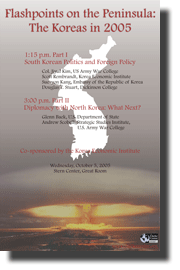
Flashpoints on the Peninsula : The Koreas in 2005

Wednesday, October 5, 2005
Flashpoints on the Peninsula : The Koreas in 2005
Stern Center, Great Room, 1:15 p.m. and 3:00 p.m.

Flashpoints on the Peninsula

Issue in Context
On Tuesday, September 13, 2005, the two Korean nations, in conjunction with the United States, China, Japan and Russia, opened dialogue in their 16th round of Cabinet-level talks in Pyongyang, North Korea. On September 19, after a series of negotiations since 2000, Pyongyang stated its intentions to abandon all existing nuclear programs and give up their nuclear weapons in a major breakthrough agreement. In exchange, the other five nations will provide energy and economic assistance.
In 1953, the Korean War ended in a truce, though never formally concluded with a peace treaty. In the years following the war, the North and South drifted farther apart as both sides were drawn into the Cold War. Communist North Korea maintained a mutually beneficial relationship with the Soviet Union, while South Korea remained close to the United States. The U.S. and South Korea have not only been close allies since then, but have also become important economic partners.
South Korea, with a GDP of over $500 billion, is now the twelfth largest economy in the world, and the Read more

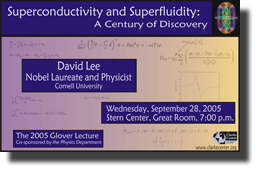
Superconductivity and Superfluidity: A Century of Discovery

Wednesday, September 28, 2005
Superconductivity and Superfluidity: A Century of Discovery
Stern Center, Great Room 7:00 P.M.Superconductivity

Issue in Context
As gases such as nitrogen or oxygen are cooled down further and further, they will at one point become liquids with similar traits to water. Helium is unique because, as it is cooled down even further, it develops some quirky qualities. For example, in extremely low temperatures, the “superfluid” helium can crawl through the tiniest of holes without any resistance and, given the chance, will crawl up and around the sides of any container.

These superfluids are reminiscent of superconductors, which have no electrical resistance. In theory, superfluids and superconductors both present novel concepts for future technologies. Physicists call these exotic states of matter “macroscopic quantum states.”

What discoveries have been made in the fields of superfluidity and superconductivity over the past century? What philosophical implications do they have? What implications might they have for future technologies? The lecture will explore these and other important questions facing the field.

About the Speaker
David Lee has enjoyed an expansive and distinguished career in the field of low-temperature physics. With his colleagues Douglas D. Osheroff and Robert C. Richardson, he has spent Read more

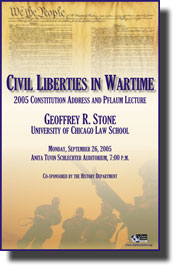
Civil Liberties in War Time

September 26, 2005
Civil Liberties in War Time
2005 Constitution Address
Anita Tuvin Schlechter Auditorium, 7:00 p.m.Civil Liberties in War Time

Issue in Context
Wartime often leads the U.S. government into bestowing various demands on its citizens to help provide for the common defense. For example, the government has enacted conscription, commandeered property, and rationed resources.

Also during those times, the government has felt it necessary to restrict certain civil liberties for the sake of national security. The Sedition Act of 1798 was implemented to silence political dissent as our founders feared a war with France. During the Civil War, habeas corpus was suspended to imprison and exile Confederate sympathizers. In the 20th century, paranoia over possible invasions and infiltrations by enemies led to the Espionage Act of 1917, the internment of Japanese-American citizens during World War II, and the explosion of McCarthyism at the dawn of the Cold War.

Now, as America is once again immersed in war, the government is trying to balance civil liberties with threats from terrorists. Soon after 9/11, Congress passed the PATRIOT ACT, which authorized law enforcement officials to use invasive methods to investigate terror suspects. As the war in Iraq intensified, especially during the 2004 election, protesters Read more

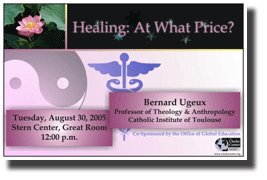
Healing: At What Price?

Tuesday, August 30, 2005
Healing: At What Price?
Stern Center, Great Room 12:00 P.M.

Healing at What Price

Issue in Context
Holistic healing refers to medical practices that seek to integrate the mind,body, and spirit. Proponents of holism argue that traditional medicine does not effectively address the spiritual and mental aspects of healing. Many holistic techniques are derived from ancient medical practices, and holistic therapy has gained popularity in the West over the past decade. According to the 2002 survey conducted by the National Center for Complementary and Alternative Medicine, 36% of Americans had used a form of alternative therapy within the past year. Criticism of holistic techniques arises when alternative therapies cannot be supported by scientific data or lack adequate testing. However, there are areas in which conventional medicine and alternative techniques complement each other. Through analysis of Sub-Saharan African and Tibetan contexts, Bernard Ugeux will share his insight into the current success of holistic therapeutic practies in the West.

About the Speaker
Bernard Ugeux currently serves as the director of the Institute of Science and Theology and the director of the Center for African Studies in Toulouse, France. In addition, Ugeux is a professor of theology at the Catholic Institute of Toulouse Read more