Past Programs

Marilyn Wann


Author, Editor, and ActivistThe Real F Word Poster for web with drop shadow

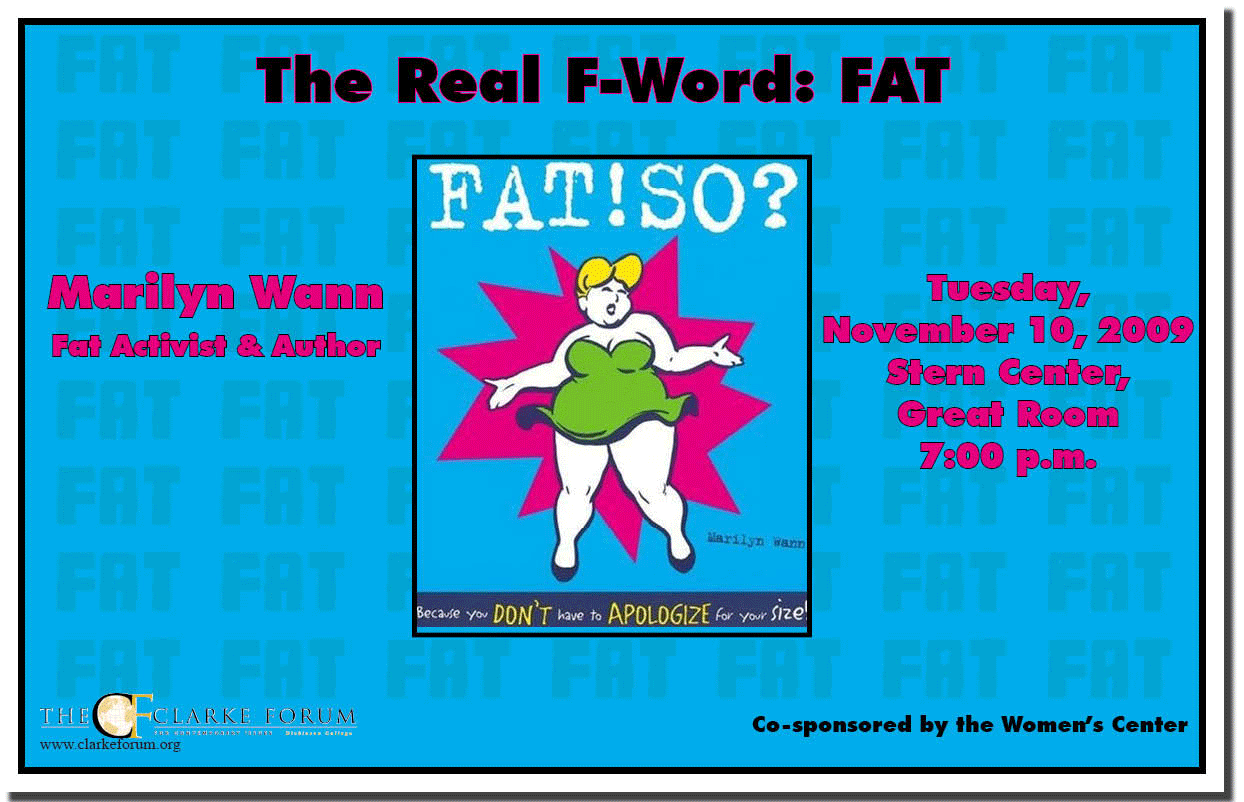
The Real F-Word: FAT

Tuesday, November 10, 2009
Stern Center, Great Room, 7:00 p.m.

Marilyn Wann offers a funny and engaging discussion of what it currently means to be fat or thin, the impact of such messages, and a revolutionary new alternative for how we should live in and think about our bodies.

Biography (provided by the speaker)
Marilyn Wann is a fat civil rights activist. She published a print ‘zine in the mid-90s called FAT!SO? and later wrote a book of the same name. Wann was centrally involved in successful passage of San Francisco’s height-weight anti-discrimination law in 2000 and lobbies for similar laws elsewhere. She has performed with several fat-positive groups: Marilyn splashed on “The Tonight Show with Jay Leno” as part of the Padded Lilies synchro swim team; shook pompoms with the Bod Squad cheerleaders who oppose weight-loss surgery; and danced with the Phat Fly Girls hip hop troupe, a Big Moves project.

Video of the Program

  Read more

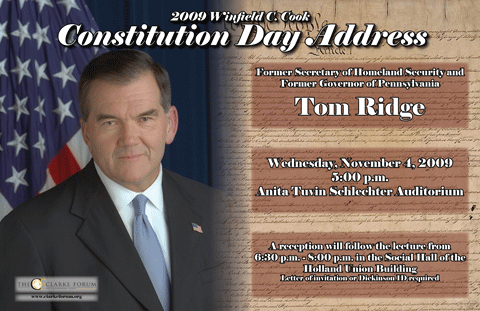
Tom Ridge – "Constitution Day Address"

Former Secretary of the Department of Homeland Security and Former Governor of Pennsylvania

Constitution Day Address Poster
Wednesday, November 4, 2009
Anita Tuvin Schlechter Auditorium – 5:00 p.m.

The annual Constitution Day Address was established by The Clarke Forum for Contemporary Issues in 1995. Each year a prominent public figure is invited to speak at Dickinson College on contemporary issues as they relate to the constitution.

A reception will follow the lecture from 6:30 p.m. – 8:00 p.m. in the Social Hall of the Holland Union Building.
Letter of invitation or Dickinson ID required.

Constitution Day
“Constitution and Citizenship Day” is normally celebrated every September 17, the day that the United States Constitution was ratified in 1787. It is intended to commemorate the signing of the Constitution and celebrate the founding ideals of the United States. The idea for Constitution Day began in 1939, when newspaper publisher William Randolph Hearst advocated for the creation of a holiday to celebrate citizenship. In 1940, the United States Senate passed a resolution to designate the third Sunday in May as “I am an American Day.” In 1952, President Harry Truman changed the name of the holiday to “Citizenship Day” and moved the date to September 17. A Read more

Sharalyn Orbaugh

Professor of Asian studies and women’s & gender studies, University of British Columbia

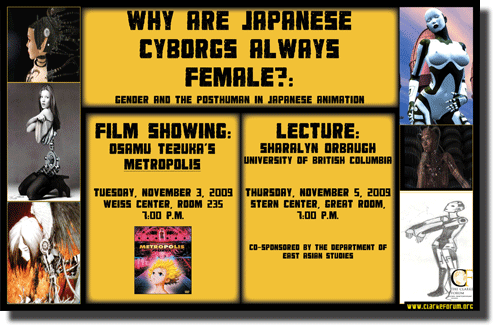
JapCyborgsPoster web

Why are Japanese Cyborgs Always Female?

Thursday, November 5, 2009
Stern Center, Great Room, 7:00 p.m.

In the robot, android or cyborg body, sex and gender are constructed and unnecessary rather than biological and functional; nonetheless, most depictions of such post-human entities retain gender and sex markers. This presentation explores the reasons behind this phenomenon in recent Japanese anime films, such as Osamu Tezuka’s Metropolis.

Co-sponsored by the Department of East Asian Studies

Topical Background
According to the Oxford English Dictionary, a cyborg is “a person whose physical tolerances or capabilities are extended beyond normal human limitations by a machine or other external agency that modifies the body’s functioning.”

The idea of the technologically enhanced human has been prevalent in fiction since Edgar Allen Poe wrote of the prosthetic General John A.B.C. Smith in his 1839 short story, “The Man that was Used Up.” Darth Vader, the Terminator, and The Six Million Dollar Man are just a few of the cyborgs that have entered American popular culture. In Japan, cyborgs frequently appear in animated works.
Japanese animation usually depicts cyborgs as female. In the cyborg body, Read more

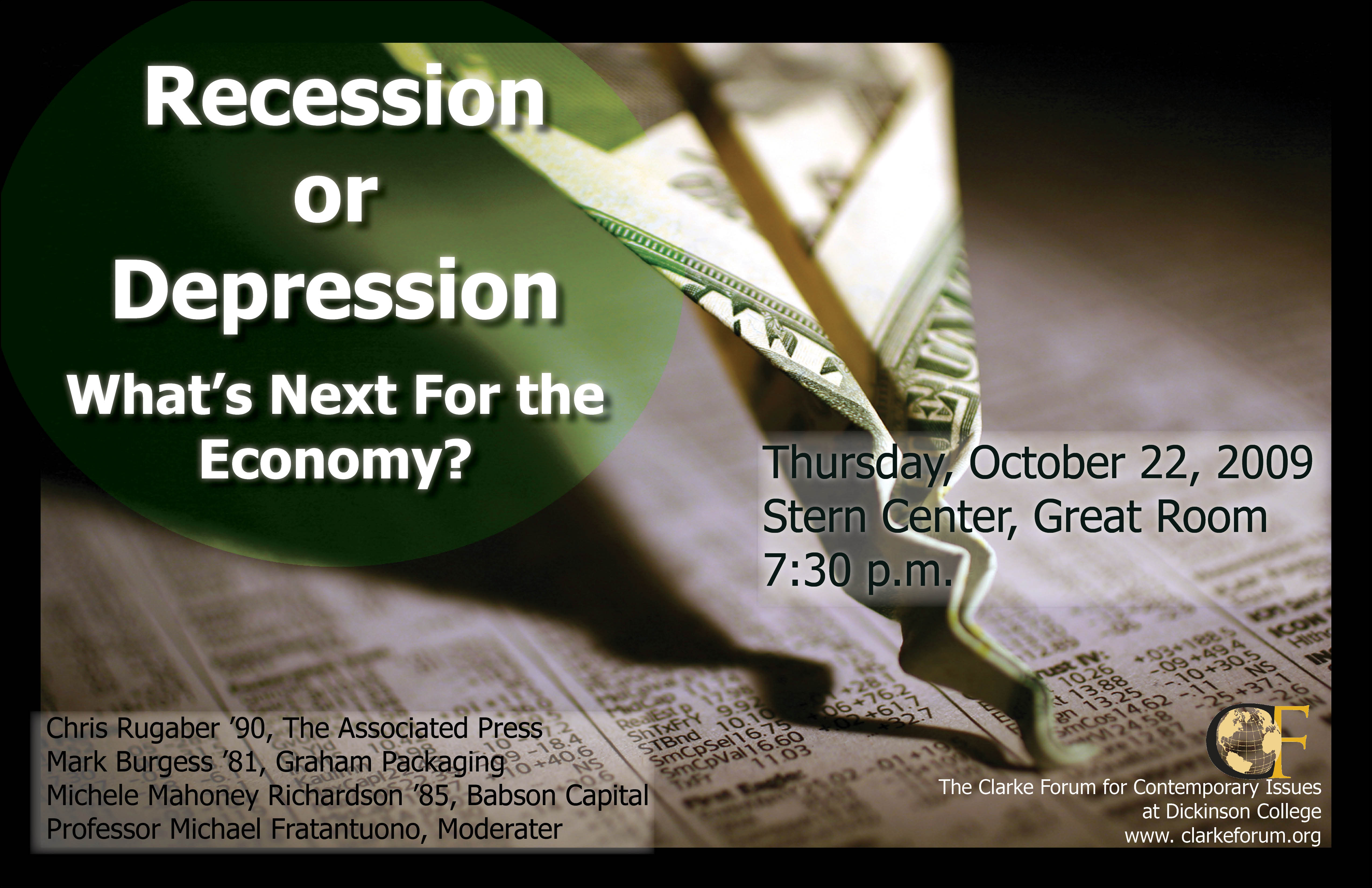
Recession or Depression? What’s Next for the Economy

Recession poster web

A Panel Discussion

Thursday, October 22, 2009
Stern Center, Great Room, 7:30 p.m.

In late 2008, many analysts referred to the downturn of the U.S. economy as the worst crisis since the Great Depression. A panel of experts affiliated with Dickinson College will assess the rationale and effectiveness of government policies implemented over the past year as a response to the downturn and will speculate about the future prospects for the U.S. economy.

Information about the Panelists
Chris Rugaber ’90 is a reporter & economics writer for The Associated Press, the largest and oldest news agency in America. He graduated from Dickinson College and received a master’s degree in political science from American University.
Mark Burgess ’81 is currently the CFO from Graham Packaging in York, PA. Prior to joining Graham, Mr. Burgess served as president and CEO, as well as CFO, of Anchor Glass Container Corporation. He holds a B.A. in economics from Dickinson College and an M.B.A. from the Fuqua School of Business at Duke University.
Michele Mahoney Richardson ’85 is the managing director at Babson Capital Management. Babson Capital Management serves as an investment advisor or financier to a broad range of institutional investors in the U.S. Read more

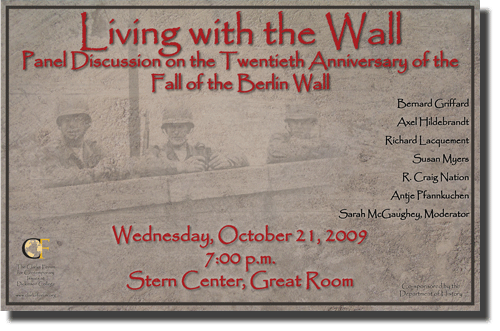
Living with the Wall

living with wall poster web

Panel Discussion on the
Twentieth Anniversary of the
Fall of the Berlin Wall

Wednesday, October 21, 2009
Stern Center, Great Room, 7:00 p.m.

For close to thirty years a wall separated East from West Berlin. Members of Dickinson College and the broader community who experienced life in Berlin during this time will discuss how the period’s experiences affected their personal and professional lives.

Panelists
Bernard Griffard, professor of strategic logistics, Center for Strategic Leadership, U.S. Army War College
Axel Hildebrandt, assistant professor of German, Moravian College
Richard Lacquement, professor of military strategy, Department of National Security and Strategy, U.S. Army War College
Susan Myers, professor of distance education, Department of Distance Education, U.S. Army War College
R. Craig Nation, director of Eurasian studies, Department of National Security and Strategy, U.S. Army War College
Antje Pfannkuchen, instructor in German, Dickinson College
Sarah McGaughey (Moderator), assistant professor of German, Dickinson College

Topical Background
Following World War II, the Allied Powers divided Germany into four occupation zones. In 1949, the Soviet Union declared its occupation zone the German Democratic Republic (GDR), which quickly became known as East Germany. Over the next decade, hundreds of thousands of Read more

Myra Donnelley

Representative of Brave New Films

Subaltern-ate Media: Brave New Films’ ‘trickle up theory’ of Mass-roots Communications

Friday, October 16, 2009
The Weiss Center, Rubendall Recital Hall, 11:30 a.m.

The Clarke Forum and the Literature/Film Association are sponsoring a presentation by Myra Donnelley of Brave New Films. Brave New Films is perhaps best known for “Walmart,” which played on campus a couple of years ago; they have also produced “Sick for Profit” and “Move On: the Movie.” Their most recent film, “Rethink Afghanistan,” just opened in New York.

Brave New Films has pioneered video activism in all manner of venues on the internet as well as in movie theaters. As The Nation reports, the organization “has created a quick-strike capability that challenges corporate media with the truth and empowers political action nationwide.” Read more

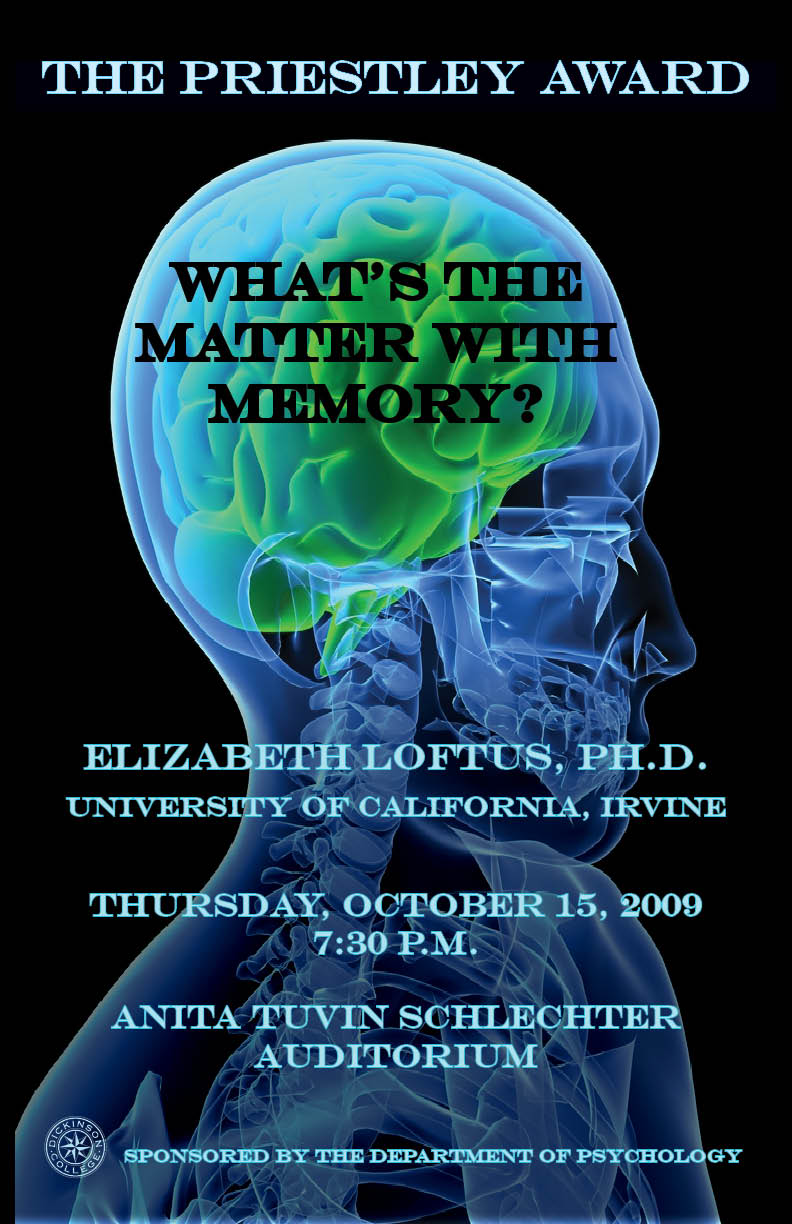
Elizabeth Loftus – "Joseph Priestley Award"

PriestleyPosterforweb

Distinguished Professor,
University of California, Irvine

What’s the Matter with Memory?

Thursday, October 15, 2009
Anita Tuvin Schlechter Auditorium, 7:30 p.m.

Sponsored by the Department of Psychology.

People have been led to remember non-existent events from the recent past as well as non-existent events from their childhood. They can be led to falsely believe that they had experiences that would have been highly traumatic had they actually happened. False beliefs have consequences for people, affecting later thoughts, intentions, and behaviors.

Biography (provided by the speaker)

Elizabeth Loftus, distinguished professor at the University of California, Irvine, holds positions in the Departments of Psychology & Social Behavior, and Criminology, Law & Society.  She is also a professor of law.  She has a faculty appointment in the Department of Cognitive Sciences and is a fellow of the Center for the Neurobiology of Learning and Memory.   Formerly, she was professor of psychology and adjunct professor of law at the University of Washington, Seattle, where she taught for 29 years.    She received her Ph.D. in psychology from Stanford University. Since then, she has published 22 books and over 450 scientific articles. Her 4th book, Eyewitness Testimony, won a National Media Award (Distinguished Contribution) from Read more

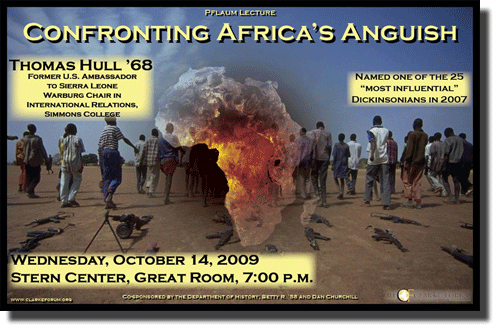
Thomas Hull ’68

Tom Hull Poster web

Metzger-Conway Fellow, Warburg Professor International Relations, Simmons College

Pflaum Lecture

Confronting Africa’s Anguish

Wednesday, October 14, 2009
Stern Center, Great Room, 7:00 p.m.

(Part of The Clarke Forum’s “Leadership in an Age of Uncertainty” series)

Co-sponsored by the Department of History and Betty R. ’58 and Dan Churchill.

Africa has been afflicted with brutal, prolonged conflicts that capture our attention, but almost incomprehensibly resist negotiated resolutions. Examining common elements in the origins and nature of these conflicts can give us insight into their intractability, suggest paths to peace, provide criteria for effective international interventions, and reveal lessons for preventing recurring conflicts.

Topical Background
During the 19th and early 20th centuries, European powers established a significant colonial presence in Africa. This ‘scramble for Africa,’ which peaked just before World War I, divided the continent and its resources into political partitions. Europeans often justified African colonialism as “the White Man’s Burden,” an obligation to “civilize” the peoples of Africa. By 1905, African soil was almost completely controlled by European governments.

As a result of colonialism and imperialism, Africa has suffered long term effects, such as the loss of important natural resources, economic devastation, cultural confusion, geopolitical division, and political subjugation.

Decolonization began Read more

The Third Branch Meets the Fourth Estate

Judicial Poster web

A Panel Discussion with
Federal and State Judges,
Media Representatives and Academics

Tuesday, October 13, 2009
Stern Center, Great Room, 2:00 p.m.

A panel of state and federal court judges, reporters and editors from major media outlets, and law school and college faculty will discuss and debate the nature, quality and depth of news coverage of courts and their function in America, the challenges that media outlets face when covering courts in an era of diminishing newsroom resources, as well as threats from various directions to judicial independence and the “public’s right to know.”

Co-sponsored by the Pennsylvania Commission on Judicial Independence, Supreme Court of Pennsylvania Read more

Carl Colby

Colby Project Poster web

Film Producer and Director

The Colby Project

Friday, October 9, 2009
Stern Center, Great Room, 3:30 p.m.

Carl Colby, an Emmy Award winning documentary filmmaker, will discuss his soon-to-be-released feature-length documentary film on his late father, William E. Colby, a lifelong CIA officer and former director of the CIA. The film uncovers the truths behind the myths of the life of an American spy and the consequences of leading such a secret life on his nation and his family.

Topical Background
The CIA
The Central Intelligence Agency, or CIA, was created in the aftermath of World War II to fulfill the country’s need for a permanent, centralized source of intelligence. Under President Truman’s National Security Act of 1947, the CIA was charged with coordinating the nation’s intelligence activities, analyzing intelligence that affected national security, and performing other duties and functions as needed. The Act also created a Director of Central Intelligence (DCI) to head the Intelligence Community and serve as the president’s principal intelligence adviser.

William Colby
William Colby began his career during World War II serving in the Office of Strategic Services (OSS), the CIA’s precursor. After the OSS’s disbandment, he joined the newly created CIA. Prior to and Read more

Peter Anderson, Esq. ’73

peterandersonfinalposter

Metzger-Conway Fellow,
Treasurer of ServeHAITI

Breaking the Cycle of Poverty in Haiti

(Part of The Clarke Forum’s series on “Leadership in an Age of Uncertainty”)
Thursday, October 8, 2009
Stern Center, Great Room, 7:00 p.m.

The discussion will focus on the cultural and economic challenges to providing healthcare to poor Haitians in the rural and mountainous region of Grand Bois. In particular, the talk will address the subtle causes of infant mortality and specific issues regarding women’s health.

Topical Background

Haiti is the poorest country in the Western Hemisphere. It was the first black republic to declare its independence in 1804 and since then it has been plagued by political violence for most of its history. After the forced resignation and exile of President Jean-Bertrand Aristide in February 2004, a provisional government was established under the United Nations Stabilization Mission in Haiti (MINUSTAH). This provisional government was charged with organizing new elections and in May 2006 Haiti inaugurated its first democratically elected president and parliament.

According to the Haiti Micah Project, a nonprofit Christian organization committed to addressing the needs of impoverished and uneducated street children in Haiti, the following bullet points provide a snapshot of Haiti’s condition:

•        The Read more

Brenda Dixon Gottschild

Cultural Historian, Actress, and Dancer

PublabBlackDancingBody web

The (Black) Dancing Body as a Measure of Culture

Thursday, October 1, 2009
Stern Center, Great Room, 7:00 p.m.

Through dance demonstrations and visual images, Dixon Gottschild examines the pervasive Africanist presence in American culture and the sociopolitical implications of its invisibility. With dance as the focus and race the parameter, she reveals Africanisms in modern and postmodern dance and American ballet.

A book signing will follow the presentation.

Topical Background
Cultural appropriation is the adoption of practices and traditions from a specific culture by another group of people. This usually involves mimicking or borrowing musical techniques, dance styles, or other art forms.

The term “Africanist,” as used by Brenda Dixon Gottschild, refers to concepts, practices, attitudes, and forms that are rooted in Africa or African culture. The term originated in the works of American anthropologist Melville J. Herskovits. In Myth of the Negro Past (1941), Herskovits was one of the first to examine African influences on both African Americans and whites in the United States. Others to use the term include author Toni Morrison, who describes Africanism in her book Playing in the Dark: Whiteness and the Literary Imagination (1992), which explores the presence Read more

Bob Weick

MarxnSohoPoster web

Actor and Monologuist

Howard Zinn’s “Marx in Soho”

Tuesday, September 29, 2009
The Depot, 7:00 p.m.

Returning to earth for one hour to clear his name, Karl Marx launches into a passionate, funny and moving defense of his life and political ideas in Howard Zinn’s brilliant, timely play, Marx in Soho. The play is an excellent introduction to Marx’s life, his passion for radical change, his analysis of society, and its relevance to current events, trends, and developments.

Topical Background
Karl Marx was born on May 5, 1818 in Trier, Germany. He studied jurisprudence and law at the University of Bonn and the University of Berlin. In 1843, the 25-year-old Marx moved to Paris, where he devoted himself primarily to studying political economy and the history of the French Revolution. In 1845, Marx moved to Brussels after the Paris authorities ordered him to leave for openly approving the assassination attempt on the King of Prussia. In 1849, Marx moved to London and remained there for the rest of his life. In London, Marx devoted himself to understanding political economy and capitalism, and to revolutionary activities. He argued that capitalism would inevitably produce internal tensions which would lead to its Read more

Nina Davenport

Documentary Film Director

Operation Filmmaker

Nina Davenport PosterWednesday, September 16 – Film Showing – Operation Filmmaker
Stern Center, Great Room, 7:00 p.m.

Thursday, September 17 – Discussion with film director, Nina Davenport
Stern Center, Great Room, 7:00 p.m.

Do-gooder intentions go disastrously wrong when Hollywood gives a young Iraqi film student the chance of a lifetime. Operation Filmmaker tells the fascinating and riveting story of this student’s odyssey in the West, which has uncanny parallels to America’s recent misadventures abroad.

Topical Background
Many Americans expected Operation Iraqi Freedom to be a quick intervention welcomed by the Iraqi people. Yet, over six years later, an American occupation continues. Hundreds of thousands of Iraqis and over 5,000 Americans have perished in the conflict since 2003. Millions have become refugees and sectarian violence persists. Our initial expectations were upset; our ignorance of Middle Eastern culture exposed.

Inspired by the 2003 MTV profile of Iraqi film student Muthana Mohmed, American actor Liev Schreiber invited the young man to intern on a Hollywood movie set. Documentary maker Nina Davenport immediately saw an opportunity: she would tape Muthana’s Hollywood internship. “I thought the film would be called The Kindness of Liev Schreiber,” she later said. However, cultural differences Read more

Dr. David Nash

Founding Dean of the Jefferson School of Population Health, Thomas Jefferson University

Real Reform — Real Leadership

Nash PosterThursday, September 10, 2009

 (Part of The Clarke Forum’s series on Leadership in an Age of Uncertainty)
The Depot, 7:00 p.m.

The United States needs real leadership to tackle the health care system’s core problems: its cost, its poor quality, its limited scope, along with pernicious incentives that pervade the entire system. Dr. Nash will provide a leadership roadmap to confront these issues.

Topical Background
Healthcare reform has recently become a heated topic of debate in American politics. President Obama made improving the quality and coverage of healthcare, while reducing its costs, a key goal for his presidency. The Obama Administration seeks to ensure affordable healthcare coverage for all Americans, reduce wasteful practices in medical and administrative offices, improve patient care, and invest in the prevention of illness and disease. The reform of American health insurance and medical practice proves to be a divisive issue, as seen by the boisterous and well attended town hall meetings and protests across the nation.

Arguments for Healthcare Reform:
• 47 million Americans are uninsured.
• The U.S. is falling behind in world rankings for health indicators Read more

Elaine Brown

Executive Director of the Michael Lewis Legal Defense Committee and former leader of the Black Panther Party

The Condemnation of Little B–New Age Racism in America

elaine Brown posterWednesday, September 9, 2009
Stern Center, Great Room, 7:00 p.m.

In 1997, Michael “Little B” Lewis, a 13 year-old black adolescent, was sentenced to life imprisonment following his adult conviction for a murder Brown says he did not commit. What is the nexus between this tragedy and the relentless ramifications of slavery for black people in America, duplicitously entrenched now as a national policy of “New Age Racism?”
This program is sponsored by The Women’s Center, Department of Women’s and Gender Studies, Department of American Studies, Department of Sociology, The President’s Office of Institutional & Diversity Initiatives, and The Office of Diversity Initiatives.

Topical Background
The case of Michael Lewis, known as “Little B,” to some extent symbolizes current race relationships in the United States. At 13 years old, Lewis was arrested, tried and convicted as an adult for a murder that Brown believes he did not commit. Lewis was subsequently sentenced to life in prison. This case is an indirect reflection of the state of race relations in the U.S., as indicated by Read more

Eric Lott

Professor of English, University of Virginia

When Bob Dylan Came Knocking

Lott Poster
Friday, September 4, 2009
Stern Center, Great Room, 4:30 p.m.

Bob Dylan popularized Eric Lott’s book by putting its title on his 2001 album “Love and Theft.” Dylan’s “lift” of the title reflected Lott’s view that appropriations are fundamental to popular culture and that artistic creativity has an important bearing on education and identity formation.

Following Professor Lott’s talk, there will be a barbecue and concerts by Structure of Feeling and Black Landlord, named the “best local band” by Philadelphia Magazine in August 2009. Concerts are co-sponsored by The Division of Student Development, the Office of Campus Life and the Multicultural Organizational Board.

Topical Background
Cultural theorist Raymond Williams claims that culture is “one of the two or three most complicated words in the English language.” Certainly the meaning of the term is highly contested.

In his book Cultural Theory and Popular Culture: An Introduction, John Storey identifies six different definitions of the term:

• The “culture which is widely favored or well liked by many people.”
• The culture which is “left over after we have decided what is high culture.”
• “Mass culture,” that is, Read more

Dr. Michael Walzer

Professor Emeritus at the Institute for Advanced Study at Princeton University and Author

Walzer Poster

Just and Unjust Wars

Wednesday, February 4, 2009
Stern Center, Great Room – 7:00 p.m.

What are the underlying principles that distinguish just from unjust wars? In particular, how do the principles of proportionality and responsibility apply to situations of asymmetric warfare, such as the recent violence in the Gaza Strip?

Topical Background
Just War Theory has two dimensions: jus ad bellum and jus in bellum. The former refers to the justification for war while the latter refers to the conduct of war. A major issue regarding both dimensions is the principle of proportionality. This principle requires that the benefits of the war must be proportional to its expected harms and that the force used must be proportional to the wrong suffered and the possible anticipated benefit. The number of civilian casualties has an important bearing on the principle of proportionality.

Other dimensions of jus ad bellum include legitimate authority, intention, and last resort. Additional dimensions of jus in bellum involve distinction and military necessity. Distinction requires that force be directed solely at enemy combatants instead of non-combatant civilians. The concept of military necessity dictates that an Read more

Violence in Gaza: A Panel Discussion

Thursday, January 22, 2009
The Depot – 7:00 p.m.

Panelists:
David Commins, Benjamin Rush distinguished chair in liberal arts and sciences and professor of history at Dickinson College
Itzchak Weismann, visiting assistant professor of history at Dickinson on leave from the University of Haifa in Israel
Sherifa D. Zuhur, research professor of Islamic and Regional Studies, U. S. Army War College
Moderated by Ed Webb, assistant professor of political science and international studies at Dickinson Read more

Ted Sorensen

Former Special Counsel & Advisor to President John F. Kennedy

From the Edge of History

Ted Sorensen Poster
Tuesday, April 28, 2009
Stern Center, Great Room – 7:00 p.m.

Booksigning to follow

In January 1953, freshman Senator John F. Kennedy hired 24-year-old Ted Sorensen as his number two legislative assistant. Over the next 11 years he became known as Kennedy’s “intellectual blood-bank” and “top policy aide.” He will talk on a variety of subjects including the McCarthy era, the Cuban Missile Crisis, the Vietnam War and the period following the assassination of JFK.

Mr. Sorensen will personally sign copies of his recently published memoir titled Counselor: A Life at the Edge of History, which will be available for purchase.

Topical Background
Throughout his long professional relationship with first Senator and then President John F. Kennedy, from 1953 to 1963, Theodore C. Sorensen witnessed many of the decade’s pivotal events first-hand, including:

•The Bay of Pigs Invasion. Prior to Kennedy’s ascension to the presidency, President Dwight D. Eisenhower’s administration formulated a plan to overthrow Cuba’s Communist leader Fidel Castro. Due to Cuba’s strategic location astride the access points from the Gulf of Mexico into the Atlantic Ocean, it is in a position to

Read more