Leadership in an Age of Uncertainty

The Clarke Forum for Contemporary Issues is establishing a series of programmatic events dedicated to the theme of leadership in an age of uncertainty. This initiative is grounded on the reality that today’s generation of Dickinson students confronts a large number of intractable political, economic, and social problems: terrorism and the proliferation of weapons of mass destruction, environmental pollution, global warming, a sustainable energy policy, the ongoing financial crisis, the federal deficit, the amount of public and private debt, the health care crisis, along with issues regarding race, ethnicity, gender, and sexual orientation, as well as technology and privacy. These issues and problems directly or indirectly pose challenges to the College and the local community that may in time require fundamental changes in institutions, values, and practices across the public, private, and non-profit sectors of American society. How Dickinsonians respond to these challenges presents us with an opportunity for reflection on the meaning of leadership in the contemporary world. This series is partially supported by a fund created by Betty R. ’58 and Dan Churchill.

Peter Anderson, Esq. ’73

peterandersonfinalposter

Metzger-Conway Fellow,
Treasurer of ServeHAITI

Breaking the Cycle of Poverty in Haiti

(Part of The Clarke Forum’s series on “Leadership in an Age of Uncertainty”)
Thursday, October 8, 2009
Stern Center, Great Room, 7:00 p.m.

The discussion will focus on the cultural and economic challenges to providing healthcare to poor Haitians in the rural and mountainous region of Grand Bois. In particular, the talk will address the subtle causes of infant mortality and specific issues regarding women’s health.

Topical Background

Haiti is the poorest country in the Western Hemisphere. It was the first black republic to declare its independence in 1804 and since then it has been plagued by political violence for most of its history. After the forced resignation and exile of President Jean-Bertrand Aristide in February 2004, a provisional government was established under the United Nations Stabilization Mission in Haiti (MINUSTAH). This provisional government was charged with organizing new elections and in May 2006 Haiti inaugurated its first democratically elected president and parliament.

According to the Haiti Micah Project, a nonprofit Christian organization committed to addressing the needs of impoverished and uneducated street children in Haiti, the following bullet points provide a snapshot of Haiti’s condition:

•        The Read more
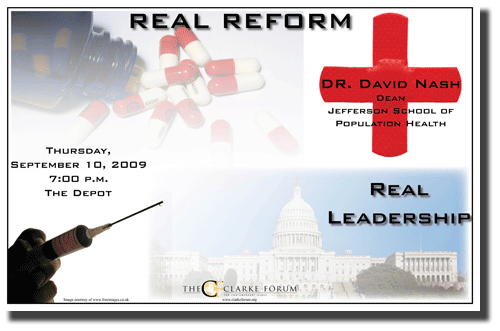
Dr. David Nash

Founding Dean of the Jefferson School of Population Health, Thomas Jefferson University

Real Reform — Real Leadership

Nash PosterThursday, September 10, 2009

 (Part of The Clarke Forum’s series on Leadership in an Age of Uncertainty)
The Depot, 7:00 p.m.

The United States needs real leadership to tackle the health care system’s core problems: its cost, its poor quality, its limited scope, along with pernicious incentives that pervade the entire system. Dr. Nash will provide a leadership roadmap to confront these issues.

Topical Background
Healthcare reform has recently become a heated topic of debate in American politics. President Obama made improving the quality and coverage of healthcare, while reducing its costs, a key goal for his presidency. The Obama Administration seeks to ensure affordable healthcare coverage for all Americans, reduce wasteful practices in medical and administrative offices, improve patient care, and invest in the prevention of illness and disease. The reform of American health insurance and medical practice proves to be a divisive issue, as seen by the boisterous and well attended town hall meetings and protests across the nation.

Arguments for Healthcare Reform:
• 47 million Americans are uninsured.
• The U.S. is falling behind in world rankings for health indicators Read more

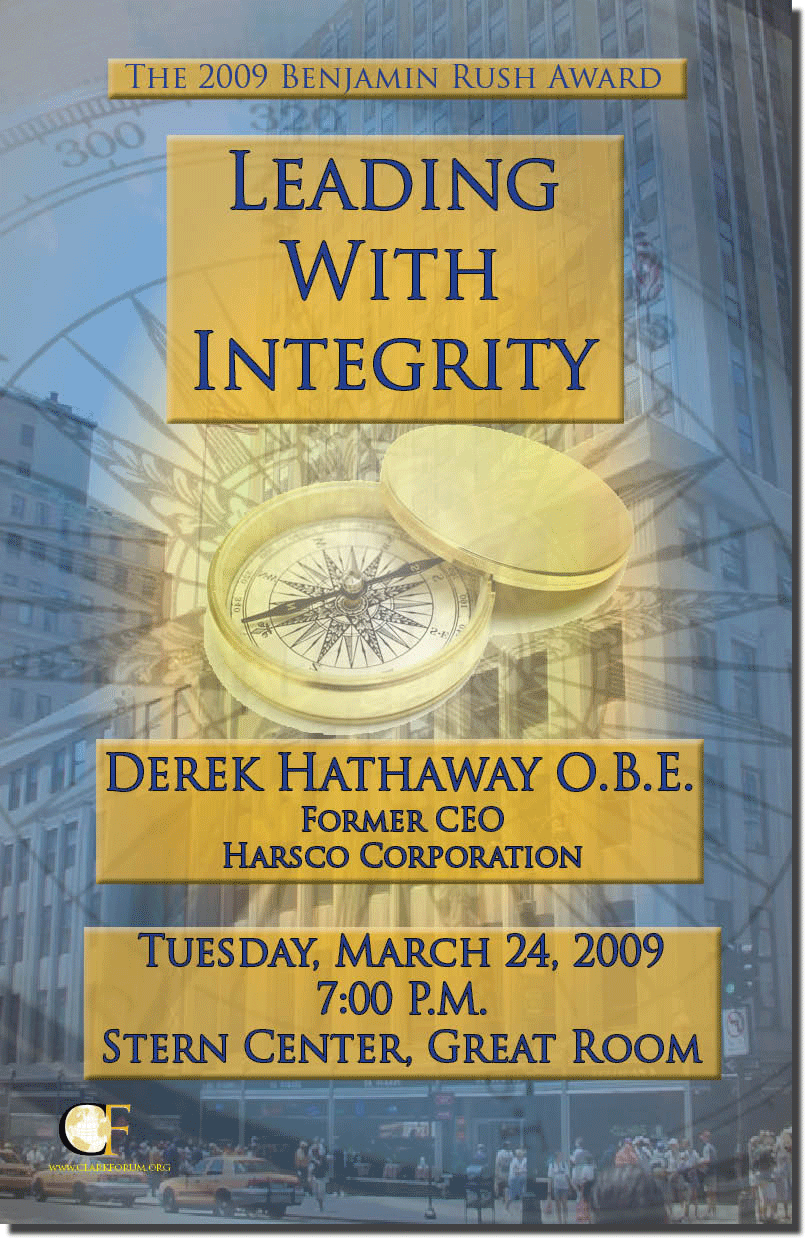
Derek Hathaway

Recently Retired Chairman and Chief Executive Officer of Harsco Corporation

Derek Hathaway Poster

Rush Award

Leading With Integrity

Tuesday, March 24, 2009
Stern Center, Great Room – 7:00 p.m.

Topical Background
According to a recent Gallup Poll, 80% of Americans believe that the moral values of our country are getting worse. Scandals and corruption in government, healthcare, law and many other sectors of our society appear to have eroded public confidence both in public and private institutions. Government scandals from both sides of the aisle have scorched the nation’s trust in the elected leadership of our government. Access to quality, trustworthy health care also remains an important issue as 59% of the country believes that the U.S. healthcare system has “major problems.” In our legal system, two-thirds of lawyers report having knowledge of “bill-padding” among their colleagues, while 55% of lawyers themselves report billing for unnecessary work. The crisis of confidence is even more obvious in the business sector.

Only three out of ten Americans reported in a recent poll that they believe Wall Street will make the right decisions regarding the current recession. In addition to a general mistrust of Wall Street, recent multi-billion dollar scandals involving business leaders, such as those Read more

What’s Wrong with Public Service? A Challenge for Higher Education

All-Day Conference Co-Sponsored by the University of Maine and Dickinson College

Monday, February 23, 2009
Stern Center, Great Room
Sessions begin at 8:30 a.m.

In the context of recent proposals to create a public service academy, what are the advantages and disadvantages of a public service career and the role higher education plays in preparing students for the challenges of such a commitment?

Conference Schedule
Public Service Conference Schedule

Co-sponsored by Betty R. ’58, and Daniel Churchill. Read more

Liberal Arts Education, Leadership and Business Management

Tuesday, November 29, 2005
2005 Rush Award
Liberal Arts Education, Leadership and Business Management
Stern Center, Great Room, 7:00 p.m.

Liberal Arts Education

Issue in Context
Marvin Suomi of the Kajima Corporation once said “Somehow we have failed miserably in communicating to students and parents the importance of a well-rounded education in the business world. Today, perhaps more than ever, we need the depth of perspective that a liberal arts education can bring to decision making, product development, leadership, and other dimensions of business.”

Based on Mr. Suomi’s statement, one can easily begin to understand how much the business world has evolved in just a few decades. In the past, there was a clear bias within firms where specialized education was strongly preferred to liberal arts education in terms of background for employment. However, as the job market has evolved, so have the criteria for employment. Increasingly, firms are looking for individuals who exhibit skills in problem solving, the capacity for cross-cultural understanding, and the ability to place key decisions in broader social and historical contexts.

As more corporations become multi-national, the demand for liberal arts educated analysts in the business world continues to soar. The value of better understanding of human nature Read more