Events

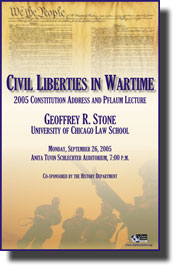
Civil Liberties in War Time

September 26, 2005
Civil Liberties in War Time
2005 Constitution Address
Anita Tuvin Schlechter Auditorium, 7:00 p.m.Civil Liberties in War Time

Issue in Context
Wartime often leads the U.S. government into bestowing various demands on its citizens to help provide for the common defense. For example, the government has enacted conscription, commandeered property, and rationed resources.

Also during those times, the government has felt it necessary to restrict certain civil liberties for the sake of national security. The Sedition Act of 1798 was implemented to silence political dissent as our founders feared a war with France. During the Civil War, habeas corpus was suspended to imprison and exile Confederate sympathizers. In the 20th century, paranoia over possible invasions and infiltrations by enemies led to the Espionage Act of 1917, the internment of Japanese-American citizens during World War II, and the explosion of McCarthyism at the dawn of the Cold War.

Now, as America is once again immersed in war, the government is trying to balance civil liberties with threats from terrorists. Soon after 9/11, Congress passed the PATRIOT ACT, which authorized law enforcement officials to use invasive methods to investigate terror suspects. As the war in Iraq intensified, especially during the 2004 election, protesters Read more

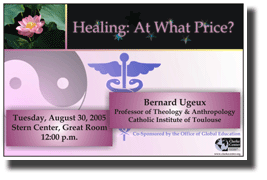
Healing: At What Price?

Tuesday, August 30, 2005
Healing: At What Price?
Stern Center, Great Room 12:00 P.M.

Healing at What Price

Issue in Context
Holistic healing refers to medical practices that seek to integrate the mind,body, and spirit. Proponents of holism argue that traditional medicine does not effectively address the spiritual and mental aspects of healing. Many holistic techniques are derived from ancient medical practices, and holistic therapy has gained popularity in the West over the past decade. According to the 2002 survey conducted by the National Center for Complementary and Alternative Medicine, 36% of Americans had used a form of alternative therapy within the past year. Criticism of holistic techniques arises when alternative therapies cannot be supported by scientific data or lack adequate testing. However, there are areas in which conventional medicine and alternative techniques complement each other. Through analysis of Sub-Saharan African and Tibetan contexts, Bernard Ugeux will share his insight into the current success of holistic therapeutic practies in the West.

About the Speaker
Bernard Ugeux currently serves as the director of the Institute of Science and Theology and the director of the Center for African Studies in Toulouse, France. In addition, Ugeux is a professor of theology at the Catholic Institute of Toulouse Read more