All posts by admin

Film Showing: The Situation

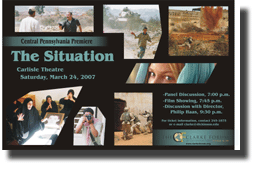
The Situation PosterSaturday, March 24, 2007 – The Carlisle Theatre
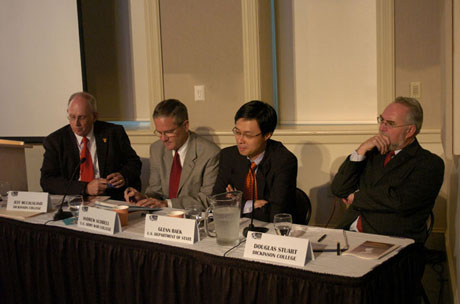
Panel Discussion – 7:00 p.m.
Film Showing – 7:45 p.m.
Discussion with Director, Philip Haas – 9:30 p.m.

Local Newspaper Reviews
The Sentinel
The Patriot-News

About the Film
The Situation, the first U.S. feature film that focuses on the occupation in Iraq, attempts to portray the conflict fairly and accurately. The film is co-written by director Philip Haas and journalist Wendell Steavenson, who spent a year reporting from Iraq. Strategically filmed in Morocco with a cast including many local actors, The Situation adeptly illustrates the interactions between Iraqis and American soldiers.
Producer Liaquat Ahamed said the idea for the film was inspired by “the feeling that, though the papers were full of Iraq, no one seemed to be able to understand it. People had a hunger to get inside the Middle East. […] News 4 reports were somehow unable to satisfy that curiosity.” Despite the mass media coverage of the war in Iraq, many people remain confused and lack a working understanding of the war and the United States’ role in the conflict. Director Philip Haas hoped to create a story that audiences could understand. He said, “you see the human toll, Read more

Film Showing and Discussion: Angels and Insects

Friday, February 16, 2007
7:00 p.m. – The Depot
Snacks Provided

Philip Haas directs this film about a poor naturalist, William Adamson, who returns home to Victorian England in 1864 after having spent years along the Amazon River where he studied all kinds of animals, mainly insects. He lost all his possessions after being shipwrecked. Forced to accept the charity of the wealthy Alabaster family, he falls in love and married their daughter. With her he starts a family, but a tragic revelation destroys their life.

Prof. Ashton Nichols will lead a discussion following the film showing.

Philip Haas is also the director of the upcoming movie, The Situation, which will have a special showing at The Carlisle Theatre on Sat., March 24 at 7:00 p.m., sponsored by The Clarke Forum. Read more

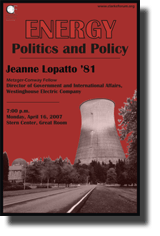
Energy Politics and Policy

Monday, April 16, 2007Lopatto Poster
7:00 p.m. – Stern Center, Great Room
Metzger-Conway Fellow
Jeanne Lopatto, director of Government and International Affairs at Westinghouse Electric Company

Ms. Lopatto advises the chairman on international policy issues and programs related to regulatory assistance to foreign countries for nuclear safety and radiation protection, non-proliferation activities, and export licensing. She also acts as liaison for the chairman’s office and other federal agencies including the Departments of Energy, State, Homeland Security, and others. She will provide an energy perspective from inside “The Beltway.” Read more

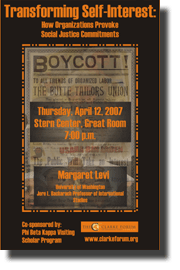
Transforming Self-Interest: How Organizations Provoke Social Justice Commitments

Thursday, April 12, 2007Levi poster
7:00 p.m. – Stern Center, Great Room
Margaret Levi, University of Washington, Jere L. Bacharach Professor of International Studies

Organizational membership sometimes changes the beliefs people hold about the nature of the world and, consequently, their behavior. This seems to be what is happening among some terrorist groups and a subset of religious, political, and labor organizations. Levi investigates this problem with an in-deph investigation of several unions in the United States and Australia, whose members routinely engage in political and social activities that do not have obvious, immediate payoffs to the membership in terms of wages, hours, and working conditions.
Co-sponsored by Phi Beta Kappa Visiting Scholar Program and Dickinson Phi Beta Kappa.

Issue in Context
Left-wing longshore union members give up time and money to fight on behalf of social justice causes from which they can expect no personal material return. Nationalists make vulnerable their freedom and their lives for the sake of seemingly unattainable goals. What beliefs and preferences guide those choices and how are they formed? Levi argues that individuals (1) develop different preferences (2) as a consequence of an organizational culture that produces contingent consent with leadership and its goals. Read more

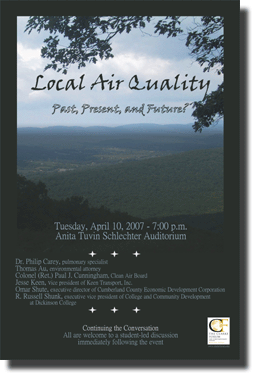
Local Air Quality: Past, Present & Future?

Air Quality Poster
Tuesday, April 10, 2007
7:00 p.m. – Anita Tuvin Schlechter Auditorium

“Continuing the Conversation”
All are welcome to stay for The Clarke Forum’s student led follow-up discussion immediately following the presentation.

Philip Carey, M.D., pulmonary specialist
Thomas Au, environmental attorney
Colonel (Ret.) Paul J. Cunningham, Clean Air Board
Omar Shute, executive director, Cumberland County Economic Development Corporation
Jesse Keen, vice president, Keen Transport, Inc.
R. Russell Shunk, executive vice president of College/Community Development at Dickinson College, Moderator

Issue in Context
Since human occupation, the Cumberland Valley has been a crossroads of commerce, trade, and travel. American Indians traversed trails through the region, along waterways and over mountains. People crossing these waterways and mountains now rely on the area’s heavy network of interstate highways. A vast logistics industry provides jobs in an economy that continues to lose manufacturing and farming. The trucks that drive through campus on Route 11 are just a slice of this network, and local air quality has diminished because of the diesel fuel emissions. A recent study by the American Lung Association indicated that the Harrisburg-Carlisle-Lebanon area has the 24th most polluted air in the nation, a factor that affects health Read more

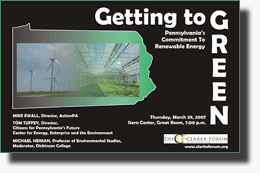
Getting to Green?: Pennsylvania's Commitment to Renewable Energy

Thursday, March 29, 2007RushPoster07

7:00 p.m. – Stern Center, Great Room

Mike Ewall, director, ActionPA
Tom Tuffey, director, Citizens for Pennsylvania’s
Future Center for Energy, Enterprise and the Environment
Michael Heiman, facilitator, geographer and professor of environmental studies, Dickinson College

A discussion of Pennsylvania’s electricity provision, reform and contribution to global greenhouse gas emissions. Panelists will discuss the alternatives state laws allow, and the advances that have been made in wind and solar energy. An open discussion will follow.

Issue in Context
As both a major industrial state and a large producer of coal, Pennsylvania leaves a significant environmental footprint. Ranked third highest in the nation for production of greenhouse gasses (behind California and Texas), Pennsylvania contributes 1 PERCENT of all human-generated global carbon dioxide. Yet recently, this hotbed of energy generation and use has also given a lot of attention to alternative energy sources and environmental protection.
Although most agree that renewable energy sources are necessary to reduce our dependence on foreign sources and the carbon footprint accompanying fossil fuels, funding and support for alternative energy sources, some of which are less than “renewable,” is controversial in the Pennsylvania legislature and across the country. In Pennsylvania, Read more

Yeats: Writing the Political Poem

Tuesday, March 27, 2007
7:00 p.m. – Stern Center, Great Room
Helen Vendler, poetry critic

Vendler, a leading authority on poetry, will speak about poems by Yeats. She will discuss “The Irish Airman” and “Easter 1916” in relation to the difficulty for poets writing about political conflict.
Co-sponsored by English, Religion, Spanish, Sirena, German, Provost of the College, American Studies, and the Dickinson Review Read more

Addressing Climate Change: A Least-Cost Strategy

Thursday, March 22, 2007
7:00 p.m. – Stern Center, Great Room
Benjamin Rush Award
Roger W. Sant

Roger W. Sant is co-founder and chairman emeritus of The AES Corporation, one of the world’s largest global power companies operating in 27 countries. Mr. Sant was assistant administrator for energy conservation and the environment at the Federal Energy Administration as well as director of the energy productivity center, affiliated with the Carnegie Mellon University.

Issue in Context
Over the past two centuries, “greenhouse gases” which trap heat in our atmosphere have caused global temperatures to increase. The concentration of “greenhouse gases” is formed from deforestation and the burning of fossil fuels. “Greenhouse gases” are critical to life for they allow the planet to remain warm. In recent years these temperatures have risen above traditional levels, providing cause for concern. Eleven out of the past 12 years have been some of the warmest years ever recorded. Levels of carbon dioxide in the atmosphere are 30 percent higher than they were during the Industrial Revolution. Polar ice caps are melting rapidly, at an average of 9 percent per decade; artic thickness has decreased 40 percent in the past 40 years. Furthermore, the number of Read more

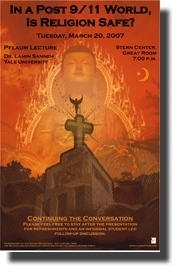
In a Post 9/11 World, is Religion Safe?

Tuesday, March 20, 2007Post 911 Poster
7:00 p.m. – Stern Center, Great Room
Pflaum Lecture
Lamin Sanneh, D. Willis James Professor of Missions and World Christianity at Yale University History Department

The lecture will assess the role of religion in the new world order and suggest how historical study can help illuminate present-day challenges.
Co-sponsored by the history department

“Continuing the Conversation”
All are welcome to stay for The Clarke Forum’s student led follow-up discussion immediately following the presentation. Refreshments provided.

Issue in Context
The spiritual dogma of Islamic Fundamentalism that prompted the 9/11 terrorist attacks horrified individuals of all religious and ethnic backgrounds, and brought the use of violence under the guise of a religious calling to the forefront of global attention. Religious responses to 9/11 varied considerably in both the United States and in countries around the world, ranging from an increased prominence of religion in society to a newfound interest in religious studies to blatantly anti-religious sentiment. In reaction to the terrorists’ Islamic Fundamentalist beliefs, individuals were particularly curious about the Islamic faith, a religion widely known for its doctrine of peace. Unprecedented global tension with regard to religious fundamentalists prompted President Bush to call for respect toward Read more

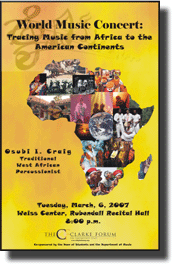
World Music Concert: Tracing Music from Africa to the American Continents

WorldMusicPosterTuesday, March 6, 2007
8:00 p.m. – Weiss Center, Rubendall Recital Hall
Osubi I. Craig, traditional West African percussionist, performing artist, musical accompanist, arts educator and advocate

1:30 p.m. – 2:45 p.m.
Students and the public are invited to the World Music Class led by Professor Wlodarski
Weiss Center – Rm. 235

The group breaks down the composition of rhythmic music in Africa and demonstrates its direct influence on modern American music from African drums to Hip-Hop. The program continues with a musical examination of the links between Afro-Brazilian percussion, Afro-Cuban percussion, and West African percussion, which highlights the wonderful sounds of Africa found in the Caribbean and South America and how they connect back to Africa.
Co-sponsored by the music department and Dean of Students Office

About the Group

Osubi Imo Craig promotes African-American culture through his work as a percussionist, artist, accompanist and advocate for the Pan-African cultural movement. He is also an educator, as he teaches audiences through workshops, demonstrations, and performances.
As a staff musician in the Alvin Ailey American Dance School of Arts in Education program, Craig has spent extensive time working with children. He has been an artist in the Philly Pops, Lincoln Read more

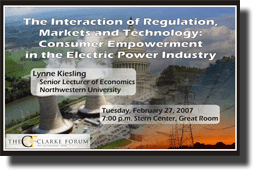
The Interaction of Regulation, Markets, and Technology: Consumer Empowerment in the Electric Power Industry

Tuesday, February 27, 2007
Kiesling Poster
7:00 p.m. – Stern Center, Great Room
Lynne Kiesling, senior lecturer of economics at Northwestern University and research scholar, Interdisciplinary Center for Economic Science at George Mason University

Widespread electric power was one of the most dramatic achievements of the 20th century, and throughout its life there has been great tension among regulation, markets, and technological change. This talk will explore those tensions, with specific applications to regulatory, economic, and technological change in the early 21st century. Digital technology has transformed how we live our lives in many ways, but it has not affected how customers consume power or control their energy choices. We will explore the important implications of these questions for economic efficiency and equity, and for environmental quality.

Issue in Context
One of the most striking characteristics of the 20th century were advancements in the physical sciences. One such defining accomplishment was the spread of electrical power throughout the United States. Since then constant tension between consumers, electrical companies, regulation, and technological change has existed. Electrical companies continually strain to generate the amount of power consumers demand. Due to environmental issues, the U.S. government begins to regulate the electrical companies, which, some Read more

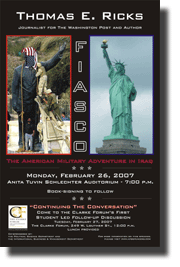
Fiasco: The American Military Adventure in Iraq

Monday, February 26, 2007Fiasco Poster
7:00 p.m. – Anita Tuvin Schlechter Auditorium
Thomas E. Ricks, Pulitizer-prize winning journalist, The Washington Post, and author

As the title, “Fiasco” suggests, Thomas E. Ricks views the American war in Iraq as a misguided exercise in folly and incompetence. His book provides a detailed and comprehensive critique for anyone interested in understanding how the United States came to go to war in Iraq, how an insurgency emerged, and how these events will affect the future of the United States. Ricks will discuss his findings and respond to questions from the audience.
Co-sponsored by International Business & Management and Political Science

Issue in Context
As of February 19, 2007, the official U.S. death toll in Iraq was 3,133, more than ten times the fatal casualties of all other coalition countries combined. The U.S. has invested about $500 billion in the Iraq war, but several audits over the last couple of years have revealed incomplete or unreliable documentation on the spending of several billions of dollars. A recent Washington Post article revealed that nearly 100 million dollars in cash intended for rebuilding projects in south-central Iraq cannot even be accounted for.
Three years ago, it Read more

Oil, War, and Geopolitics: The Global Struggle Over Disappearing Petroleum

Thursday, February 22, 2007
Klare Poster
7:00 p.m. – Stern Center, Great Room
Michael Klare, Five Colleges professor of peace and world security studies

As we move deeper into the 21st century, the global demand for energy in all its forms is rising at breakneck speed, but the global supply is failing to keep pace, producing intensified competition between the major consuming nations — especially the United States, China, Japan, and the European powers — for access to the available supply. On top of this, the center of gravity of world energy output is moving inexorably from the Global North to the Global South, producing increased anxiety and uncertainty over the reliability and safety of international energy shipments. Both of these trends are contributing to the increased militarization of energy policy. Unless more is done to reduce our reliance on hydrocarbons, we can expect a global epidemic of “resource wars” over oil and other sources of energy.
Co-sponsored by Environmental Science, International Studies, International Business & Management, and Political Science.

Issue in Context

The actions of the U.S. in the Middle East during the past twenty years have been the subject of considerable debate. In his 2001 article “Geopolitics of War” Read more