
 Anita Tuvin Schlechter Auditorium, 7 p.m.
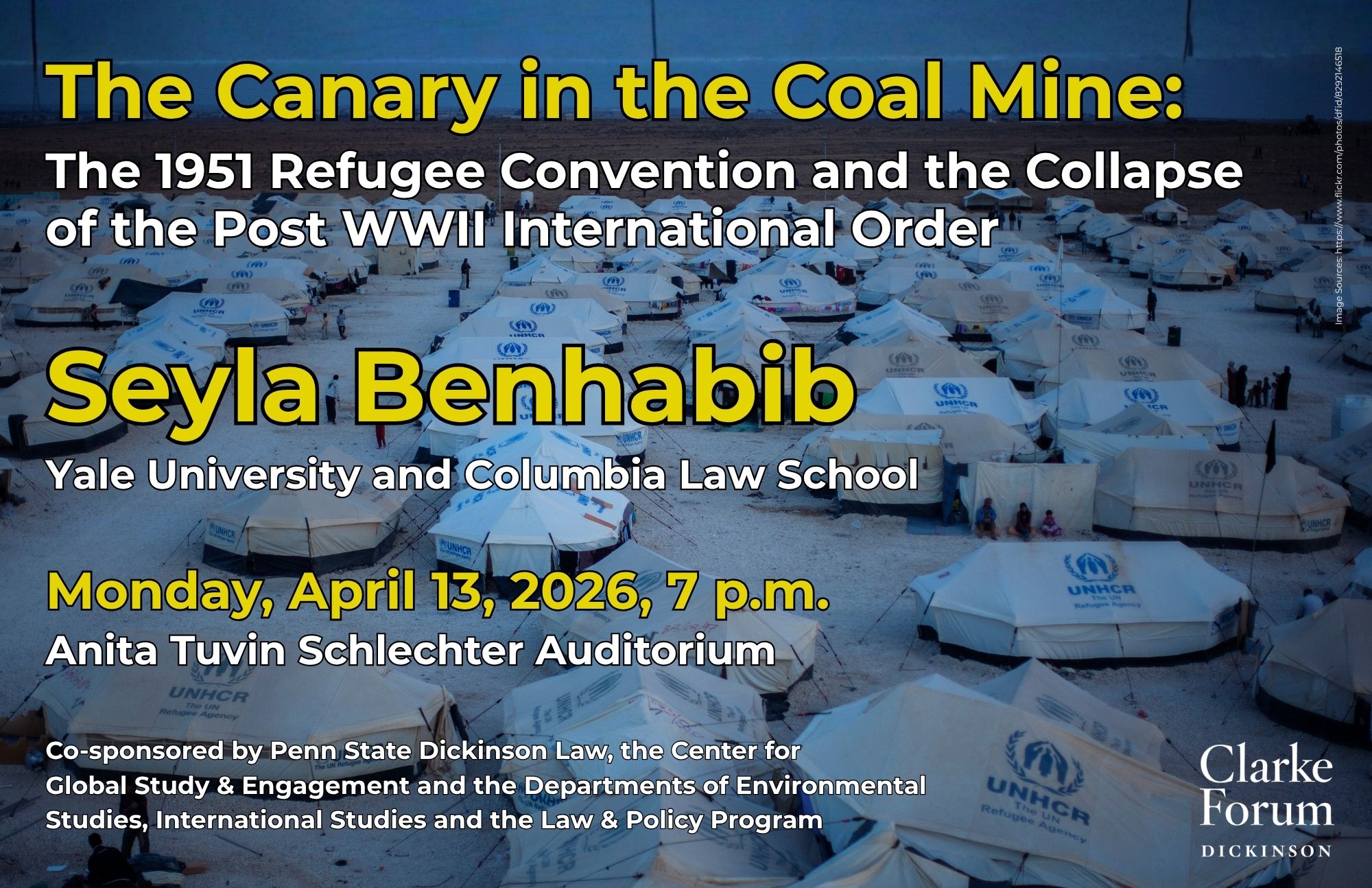
The Canary in the Coal Mine: The 1951 Refugee Convention and the Collapse of the Post WW II International Order
Seyla Benhabib is the Eugene Meyer Professor of Political Science and Philosophy at Yale University Emerita and Senior Research Fellow at Columbia Law School and the Center for Contemporary Critical Thought
The 1951 Refugee Convention is one of the most important human rights documents of the post-WW II period. Like the Universal Declaration of Human Rights (on which it is based) and the Genocide Convention, both of 1948, it embodied the hopes and aspirations of a new world order. Never again would those persecuted on account of their race, religion, ethnicity, political beliefs, and social group fail to find protection and refuge in countries other than those in which such persecution occurred.
The 1951 Convention, however, from the beginning was beset with some difficulties: first, it originally excluded countries of the Global South, whether by omission or by design. To this day, India is not a signatory of the Convention because the India-Pakistan War could find no place within its framework. Likewise, the categories of “protected groups,” named in the Convention, were based on essentializing assumptions and excluded gender persecution. Furthermore, the condition that to qualify for refugee status, a person had to show “reasonable fear of persecution” accompanied by detailed documentation, led to inevitable bureaucratic and juridical entanglements which were, in part, responsible for many states’ failure to comply with it.
Today, the utopian hope framed in the Convention that the persecuted would find safe haven and that there could be a world without such persecution, lies in smithereens. Major signatories, such as the United States and the European Union, have developed all sorts of “non-entrée” (no entry), rendition and displacement techniques which have created “lawless zones and rightless subjects,” as Ayelet Shachar and I call this process in our new edited collection (Cambridge University Press, 2025). The inherent dilemmas in complying with the 1951 Convention may thus be the canary in the coalmine which anticipated the destructive policies of the new Trump Administration vis-à-vis a world order based on international law and human rights.
This program is presented by the Clarke Forum for Contemporary Issues and co-sponsored by Penn State Dickinson Law, the Center for Global Study & Engagement and the departments of environmental studies, international studies and the law & policy program.
Biography (provided by the speaker)
Seyla Benhabib is the Eugene Meyer Professor of Political Science and Philosophy at Yale University Emerita and senior research fellow at Columbia Law School and the Center for Contemporary Critical Thought. She was the president of the Eastern Division of the American Philosophical Association in 2006-07 and has been a member of the American Academy of Arts and Sciences since 1995. She was nominated a corresponding member of the British Academy of Social Sciences and the Humanities in 2017. She has previously taught at the New School for Social Research and Harvard Universities, where she was professor of government from 1993-2000 and chair of Harvard’s Program on Social Studies from 1996-2000.
Professor Benhabib is the recipient of the Ernst Bloch (2009), the Leopold Lucas Prize from the Theological Faculty of the University of Tubingen (2012), the Meister Eckhart Prize (2014:); the Adorno Prize (2024;one of Germany’s most prestigious philosophical prizes) and the Hannah Arendt Prize of 2025. A Guggenheim Fellowship recipient (2011-12), she has been research affiliate and senior scholar in many institutions in the US and in Europe including Berlin’s Wissenschaftskolleg (2009), NYU Strauss Center for the Study of Law and Justice (2012), the European University Institute in Florence (Summer 2015), Center for Gender Studies at Cambridge University ( Spring 2017), Columbia University Law School (Spring 2016; Spring 2018) and Center for Humanities and Critical Theory, Humboldt University Berlin (Summer 2018).
Professor Benhabib holds honorary degrees from the Universities of Utrecht (2004), Valencia (2010), Bogazici University in Istanbul (2012), Georgetown University (2014) University of Geneva Division of the Social Sciences (Fall 2018) and the University of Leuven and Université de Louvain (2023).
Her work has been translated into German, Spanish, French, Italian, Turkish, Swedish, Russian, Serbo-Croatian, Hebrew, Polish, Japanese and Chinese and she has also edited and coedited 10 volumes on topics ranging from democracy and difference to the rights of migrant women and children; the communicative ethics controversy and Hannah Arendt.
Her most recent books include: At the Margins of the Modern State. Critical Theory and Law (2025); Exile, Statelessness and Migration. Playing Chess with History from Hannah Arendt to Isaiah Berlin (Princeton University Press, 2018); Dignity in Adversity: Human Rights in Troubled Times (UK and USA: Polity Press, 2011); Gleichheit und Differenz. Die Würde des Menschen und die Souveränitätsansprüche der Vőlker ( Equality and Difference. Human Dignity and Popular Sovereignty. Bilingual edition in English and German: Mohr Siebeck, 2013); edited with Volker Kaul, Toward New Democratic Imaginaries – Istanbul Seminars on Islam, Culture, and Politics (Springer 2016); The Rights of Others. Aliens, Citizens and Residents (2004), winner of the Ralph Bunche award of the American Political Science Association (2005) and the North American Society for Social Philosophy award (2004); Another Cosmopolitanism: Hospitality, Sovereignty and Democratic Iterations, with responses by Jeremy Waldron, Bonnie Honig and Will Kymlicka (Oxford University Press, 2006) among others.
The volume, Migrations and Mobilities: Gender, Borders and Citizenship (NYU Press, 2009), co-edited with Judith Resnik from the Yale Law School has been named by Choice one of the outstanding academic books of the year. She has also edited, together with Ayelet Shachar of the University of Toronto, Lawless Zones, Rightless Subjects. Migration, Asylum, and Shifting Borders (2025).